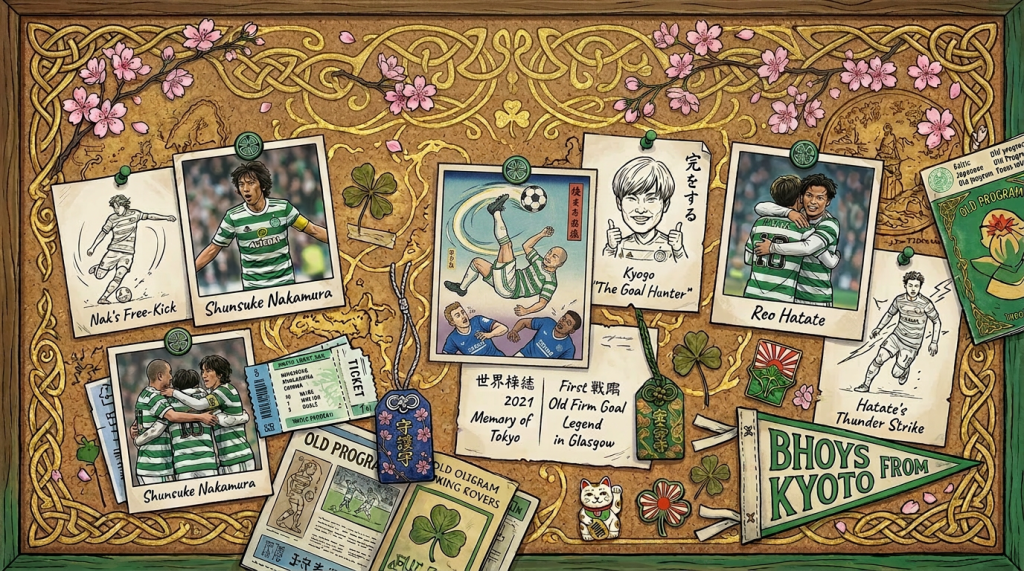
There are moments in football when time seems to slow, when the noise of the stadium fades into something softer, something almost sacred. Celtic Park has known many such moments. It has known the roar of triumph, the sting of defeat, the electricity of European nights, the warmth of domestic dominance. Yet every so often, there comes a moment that feels different. A moment that feels like the closing of a chapter rather than the turning of a page. A moment when the wind carries with it the scent of memory rather than anticipation.
This is one of those moments.
For Celtic, the Japanese era has been more than a recruitment strategy, more than a tactical evolution, more than a cultural experiment. It has been a story. A story written in green and white, but also in the delicate pink of cherry blossoms drifting across a Glasgow sky. A story of players who travelled across continents not merely to play football, but to weave themselves into the fabric of a club that thrives on identity, emotion and myth.
And now, as Daizen Maeda and Reo Hatate stand on the threshold of departure, as whispers of new adventures grow louder, as Transfermarkt pages refresh with rumours and valuations, the petals begin to fall. Not in sadness, but in beauty. Not in despair, but in gratitude. Their time at Celtic has almost certainly reached its final stanza, and with that comes the perfect moment to look back. To reflect. To honour. To understand what this era has meant.
Because eras do not end with announcements. They end with feelings. They end with the quiet realisation that something precious is slipping into memory. They end with supporters looking at the pitch and knowing that the players who defined a generation of football may never grace it again in the same colours. They end with a sense of stillness, a sense of reverence, a sense of wanting to hold on to every detail before it fades.
The Japanese era at Celtic deserves that reverence.
It deserves to be remembered not as a collection of signings, but as a cultural bridge. A bridge between Glasgow and Tokyo, between the roar of the North Curve and the disciplined hum of the J-League, between the raw emotion of Scottish football and the quiet precision of Japanese craft. It deserves to be remembered as a time when Celtic expanded its emotional geography, when the club’s identity stretched across oceans and found new expression in players who brought humility, discipline and fire.
It deserves to be remembered as a time when Celtic Park became a stage for a different kind of poetry.
Daizen Maeda, the relentless storm. Reo Hatate, the painter of passing lanes. Kyogo Furuhashi, the smile that lit the era. Tomoki Iwata, the quiet anchor. Yuki Kobayashi, the fleeting promise. Yosuke Ideguchi, the tragedy of injuries. Hayato Inamura and Shin Yamada, the whispers of a future that may yet bloom.
Together, they formed something rare. Something that felt intentional, not accidental. Something that felt like destiny rather than coincidence. Ange Postecoglou did not simply sign players. He brought with him a philosophy shaped by his years in Yokohama, a philosophy that valued movement, discipline, humility and courage. He brought with him a belief that Japanese footballers possessed qualities that could elevate Celtic not only tactically, but spiritually.
And he was right.
The Japanese players who arrived under his guidance did not merely adapt to Celtic. They transformed it. They brought a new tempo, a new rhythm, a new way of seeing the game. They brought a sense of unity, a sense of purpose, a sense of professionalism that seeped into the dressing room and reshaped the culture. They brought a quiet fire that burned brightly on the pitch and warmly off it.
And now, as Maeda and Hatate prepare to leave, that fire flickers in a different way. It flickers with nostalgia. It flickers with pride. It flickers with the knowledge that their time at Celtic will be remembered not only for goals and assists, but for the feeling they created. The feeling of watching something new, something beautiful, something that felt like flight.
This retrospective is not a eulogy. It is a celebration. It is a chance to honour the players who carried Celtic’s hopes across continents and returned with memories that will last a lifetime. It is a chance to acknowledge that football is not only about what happens on the pitch, but about the stories that surround it. It is a chance to recognise that the Japanese era at Celtic was a story worth telling, a story worth cherishing, a story worth preserving.
The petals are falling. The era is ending. But the beauty remains.
And now, with the wind shifting and the future calling, it is time to look back. To remember. To celebrate. To let the story unfold one last time.
Shunsuke Nakamura and the first light that broke the horizon
Before the era of Maeda’s relentless fire and Hatate’s elegant brushstrokes, before Kyogo’s smile lit the east end of Glasgow, before Celtic became a home for a generation of Japanese footballers, there was a single beam of light breaking the horizon. A quiet genius. A man who carried himself with the humility of a monk and the artistry of a poet. A player who did not simply play football, but elevated it into something closer to calligraphy.
Shunsuke Nakamura was the dawn.
When he arrived at Celtic in 2005, Scottish football was a different world. The league was more physical, more chaotic, more rooted in the traditional rhythms of British football. Flair players were admired, but often mistrusted. Technical players were appreciated, but often doubted. Into this landscape stepped Nakamura, slight of frame, soft of voice, gentle in demeanour. Many wondered whether he would survive the cold winds of the Scottish game.
He did not survive it. He transformed it.
Nakamura played football as if he were painting on silk. Every touch was deliberate. Every pass was a sentence in a language only he fully understood. Every free kick was a moment when the world seemed to hold its breath. Celtic supporters learned quickly that when Nakamura stood over the ball, time itself bent in anticipation. The stadium fell silent. The air thickened. The moment stretched.
And then the ball would arc, curl, dip and kiss the net with the grace of a falling petal.
His free kick against Manchester United remains one of the most iconic moments in Celtic’s modern history. Not simply because of the opponent, or the stakes, or the roar that followed, but because of the purity of the strike. It was a moment that transcended football. A moment that felt like art. A moment that announced to Europe that Celtic had a maestro in their midst.
But Nakamura’s legacy was not built on free kicks alone. It was built on the way he saw the game. The way he moved between lines. The way he created space where none existed. The way he played with a serenity that contrasted beautifully with the chaos around him. He was the calm in the storm. The stillness in the noise. The elegance in the battle.
He was also the first Japanese player to truly become a Celtic icon. Others had played in Europe before him, but none had captured the heart of a club in the way Nakamura did. He became a symbol of something new. A symbol of Celtic’s ability to embrace players from different cultures. A symbol of the beauty that could flourish in a league known for its grit. A symbol of the bridge that would one day connect Glasgow to Japan in ways no one could yet imagine.
When Nakamura returned to Glasgow years later, as reported by The Celtic Star, the reception he received was not merely warm. It was reverential. Supporters spoke of him not as a former player, but as a cherished memory. A chapter of their lives. A piece of Celtic’s soul. His presence evoked nostalgia, pride and gratitude. He was not simply remembered. He was adored.
And in many ways, he was prophetic.
Nakamura showed Celtic that Japanese players possessed a unique blend of humility, discipline and artistry. He showed that they could thrive in Scotland, not by abandoning their identity, but by embracing it. He showed that Celtic Park was a stage large enough for their talent and a home warm enough for their spirit. He showed that football could be a cultural exchange, not merely a transaction.
He planted the seed.
Years later, when Ange Postecoglou arrived with his vision shaped by Yokohama, when he spoke of Japanese players with admiration and certainty, when he brought Kyogo, Maeda, Hatate and others to Glasgow, it felt less like a revolution and more like a continuation. A continuation of the path Nakamura had carved with quiet brilliance. A continuation of the bridge he had begun to build. A continuation of the story he had started writing with his left foot.
Nakamura was the first light. The first blossom. The first whisper of a future that would one day bloom into something extraordinary.
And as we look back now, as the Japanese era reaches its twilight, as Maeda and Hatate prepare to leave, it becomes clear that none of this would have been possible without him. He was the origin. The inspiration. The gentle spark that ignited a fire that would burn brightly for nearly two decades.
In the story of Celtic’s Japanese era, Nakamura is not merely a chapter. He is the prologue. The foundation. The quiet heartbeat beneath everything that followed.
And as the petals fall on this era, his light still glows on the horizon.
The Ange revolution and the arrival of a new generation
If Shunsuke Nakamura was the first light on the horizon, then Ange Postecoglou was the sunrise that followed. His arrival at Celtic felt like a shift in the atmosphere, a change in the colour of the sky, a moment when the club inhaled deeply and exhaled something new. He came from Yokohama with a philosophy forged in the heat of Japanese football, a philosophy that valued movement, discipline, humility and courage. He came with a belief that Celtic could be rebuilt not through noise, but through clarity. Not through chaos, but through conviction. Not through fear, but through joy.
And with him came a new generation of Japanese players who would reshape Celtic’s identity.
Kyogo Furuhashi was the first. His signing felt like a whisper at first, a quiet rumour from the J-League, a name unfamiliar to many in Scotland. But Ange knew. He had seen Kyogo glide across pitches with the grace of a dancer and the sharpness of a blade. He had seen the intelligence of his movement, the purity of his finishing, the warmth of his personality. He knew Kyogo would not simply adapt to Celtic. He would illuminate it.
Then came Daizen Maeda, the relentless storm. A player who did not run so much as he devoured ground. A player whose press felt like a force of nature, whose energy seemed to come from some inexhaustible source deep within him. Ange had coached him before. He knew the fire that burned in Maeda’s chest. He knew the discipline, the humility, the hunger. He knew Celtic Park would fall in love with him.
Reo Hatate followed, the painter of passing lanes. A midfielder who saw the game in colours and shapes, who played with a kind of elegant inevitability, who could glide through pressure as if the ball were an extension of his own heartbeat. Ange knew Hatate was special. He knew his intelligence, his technique, his ability to change the rhythm of a match with a single touch. He knew Celtic had found a player who could elevate the entire team.
Yosuke Ideguchi arrived too, carrying with him the weight of expectation and the tragedy of injuries. His Celtic story would be short, but his presence mattered. He was part of the wave, part of the cultural shift, part of the moment when Celtic opened its doors to Japan in a way that felt intentional and profound.
Tomoki Iwata joined later, a quiet anchor, a player whose calmness steadied the midfield, whose discipline reflected the values Ange cherished. Yuki Kobayashi arrived with promise, a defender whose elegance on the ball hinted at a future that never fully materialised.
Together, they formed something rare. Something that felt like destiny rather than design. Something that felt like Celtic had tapped into a new source of energy, a new cultural rhythm, a new way of understanding the game. The Japanese players did not simply join Celtic. They transformed it.
They brought with them a sense of unity, a sense of humility, a sense of professionalism that seeped into the dressing room and reshaped the culture. They brought a quiet fire that burned brightly on the pitch and warmly off it. They brought a discipline that elevated standards, a work ethic that inspired teammates, a joy that spread through the squad like sunlight through leaves.
And Celtic embraced them.
Supporters learned their songs. Children wore their names on their backs. Japanese flags fluttered in the stands. Celtic Park became a place where cultures met, where languages blended, where football became a bridge between worlds. The club’s social media exploded with Japanese engagement. Merchandise flew across oceans. Journalists in Tokyo wrote about Celtic with fascination and affection.
This was not a recruitment trend. This was a cultural exchange.
Ange Postecoglou understood that football is not only about tactics. It is about people. It is about identity. It is about finding players whose values align with the club’s soul. And the Japanese players he brought to Celtic embodied those values. Humility. Discipline. Courage. Community. A willingness to run, to fight, to sacrifice, to give everything for the badge.
They fit Celtic because they understood Celtic.
And Celtic understood them.
The Ange revolution was not simply a tactical shift. It was a philosophical one. It was a moment when Celtic embraced a new way of thinking, a new way of playing, a new way of being. It was a moment when the club opened its heart to a generation of players who would leave an imprint deeper than goals and assists.
It was the beginning of an era that would bloom beautifully, brilliantly and briefly.
And now, as that era reaches its twilight, it becomes clear that Ange did not just bring players to Celtic. He brought a legacy.
A legacy that will endure long after the final whistle of Maeda and Hatate’s Celtic careers.
The golden years: Maeda, Hatate, Kyogo and the football that felt like flight
There are periods in a club’s history when football stops feeling like a sequence of matches and begins to feel like a season‑long dream. Moments blur into memories, memories blur into myth, and myth becomes the way supporters remember the world. Celtic’s Japanese era reached its golden years in a way that felt almost unreal, as if the team were not simply playing football but performing something closer to theatre, something closer to dance, something closer to flight.
At the heart of this era were three players who defined its rhythm, its colour, its emotion. Daizen Maeda, Reo Hatate and Kyogo Furuhashi. Three players who arrived from different corners of Japan, carrying different stories, different strengths, different spirits, yet somehow fit together with the precision of a poem. They were not a trio by design. They became a trio by destiny.
Daizen Maeda was the heartbeat. A player who did not run so much as he surged. A player whose energy seemed to come from a place beyond physical conditioning, a place deeper, a place spiritual. Watching Maeda press was like watching a storm roll across the pitch. He hunted defenders with a relentlessness that felt almost supernatural. He chased lost causes until they became chances. He turned pressure into panic, panic into mistakes, mistakes into goals.
But Maeda was more than a runner. He was a symbol. A symbol of humility, of discipline, of quiet leadership. His teammates spoke of him with admiration. Viljami Sinisalo called him an amazing man. Kieran Tierney praised his character. Martin O’Neill admitted that Maeda’s presence had changed the dynamic of the squad. Even when he was not scoring, he was shaping games. Even when he was not in the headlines, he was in the heartbeat of the team.
And then there were the moments. The overhead kick against Rangers, a goal that felt like it had been plucked from a dream. The wry smile he gave reporters afterward, as if he himself could not quite believe what he had done. The day he captained Japan against Scotland, a moment that felt like a bridge between two footballing worlds. The pep talks he gave to teammates returning from injury, quiet words that carried weight. The interviews where he spoke of Celtic with a sincerity that made supporters fall in love with him all over again.
Reo Hatate was the soul. A midfielder who played football as if he were painting on water. His touch was soft, his movement fluid, his vision expansive. He saw the game in patterns that others could not perceive. He played passes that seemed to defy geometry. He glided through pressure with a grace that felt almost fragile, as if he were made of something lighter than the rest of us.
His debut against Rangers was the kind of moment that becomes folklore. A goal struck with the confidence of a veteran, a performance that announced him as a player of rare intelligence. He scored long range goals that bent the air. He threaded passes that split defences like silk. He controlled matches with a serenity that made the chaos around him feel irrelevant.
But Hatate’s story was not without complexity. Reports from Celtic Way hinted at a complicated relationship with Martin O’Neill, a tension between brilliance and expectation. There were injuries, moments of frustration, whispers of departures. Yet through it all, Hatate remained a player whose presence elevated Celtic. When he played, the team felt different. More fluid. More intelligent. More alive.
Kyogo Furuhashi was the joy. A striker whose smile could light the east end of Glasgow even on the coldest winter night. A player who scored goals with the precision of a surgeon and the delight of a child. His movement was poetry. His finishing was instinct. His connection with the supporters was immediate and profound.
Kyogo scored goals that defined seasons. Cup final goals. Derby goals. Goals that felt inevitable the moment he began his run. He played with a purity that made football feel simple again. He celebrated with a joy that reminded supporters why they fell in love with the game in the first place.
Together, Maeda, Hatate and Kyogo created a style of football that felt like flight. Celtic moved with a tempo that overwhelmed opponents. They pressed with a unity that suffocated. They attacked with a fluidity that felt choreographed. They played with a joy that spread through the stadium like sunlight.
And they were not alone. Tomoki Iwata anchored the midfield with quiet excellence. Yuki Kobayashi showed flashes of elegance before fading from the picture. Yosuke Ideguchi battled injuries with courage. Young prospects like Hayato Inamura and Shin Yamada represented the future, the next blossoms waiting to bloom.
These were the golden years. The years when Celtic felt unstoppable. The years when the Japanese players were not simply part of the team, but part of the identity. The years when Celtic Park felt like a place where cultures met, where football became a shared language, where the roar of the crowd blended with the discipline of the J-League to create something new, something beautiful, something unforgettable.
And now, as Maeda and Hatate prepare to leave, these years feel even more precious. Even more luminous. Even more worthy of remembrance.
Because eras like this do not come often. And when they do, they leave behind a glow that lasts long after the final whistle.
The cultural impact: how Japan changed Celtic and how Celtic changed Japan
Football is often spoken of as a global game, but only rarely does it feel truly global in spirit. Transfers happen across continents every day, yet most of them are transactions rather than transformations. Most are movements of players, not movements of culture. Most are changes of shirt, not changes of identity. But every so often, a club and a country find each other in a way that feels deeper, richer and more meaningful than the usual rhythms of the sport.
That is what happened between Celtic and Japan.
The Japanese era at Celtic was not simply a period of successful recruitment. It was a cultural exchange that reshaped both sides of the bridge. It was a moment when Celtic’s identity expanded across oceans, when the club’s emotional geography stretched from Glasgow’s east end to the neon glow of Tokyo, when supporters in Scotland and supporters in Japan found themselves connected by a shared love for a team that suddenly felt bigger than borders.
Japan changed Celtic. And Celtic changed Japan.
The first shift was visible in the stands. Japanese flags began to appear at Celtic Park, fluttering beside the tricolours and the saltire, symbols of a new chapter in the club’s story. Supporters learned Japanese chants. Children wore Kyogo’s name on their backs. Fans spoke of Maeda and Hatate with the same affection they once reserved for homegrown heroes. Celtic Park became a place where cultures met, where languages blended, where football became a shared language that needed no translation.
The second shift was visible online. Celtic’s social media presence in Japan exploded. Match highlights were shared across Japanese platforms. Interviews were translated. Japanese journalists travelled to Glasgow to cover matches. The club’s official channels saw engagement from fans thousands of miles away, fans who woke up at dawn to watch Celtic play, fans who felt a connection to the club because their countrymen were not just participating, but starring.
The third shift was visible in the dressing room. Japanese players brought with them a sense of humility, discipline and professionalism that elevated the standards of the entire squad. They trained with intensity. They prepared with precision. They carried themselves with quiet dignity. They embodied values that resonated deeply with Celtic’s own traditions of hard work, community and selflessness.
Teammates spoke of them with admiration. Coaches praised their mentality. Staff members described them as respectful, kind and dedicated. They were not simply players. They were examples. They were reminders that football is not only about talent, but about character.
And Celtic changed Japan too.
The club became a phenomenon in Japanese football culture. Young players in Japan began to speak of Celtic as a dream destination. The J-League media covered Celtic matches with the same enthusiasm they reserved for domestic giants. Japanese fans began to follow the Scottish Premiership, learning its rivalries, its history, its rhythms. Celtic became a symbol of opportunity, a place where Japanese players could shine on the European stage without losing their identity.
The Celtic Star reported on Japanese fans travelling to Glasgow, making pilgrimages to Celtic Park, standing in the cold Scottish air with tears in their eyes as they heard You’ll Never Walk Alone echo through the stadium. For them, Celtic was not just a club. It was a connection. A bridge. A place where their culture was not only accepted, but celebrated.
The cultural impact extended beyond the pitch. Celtic shirts became common in Japanese cities. Children imitated Kyogo’s celebrations. Football academies in Japan referenced Celtic’s style of play. Japanese commentators spoke of Celtic with warmth and familiarity. The club became part of the Japanese footballing imagination.
And then there were the stories. The small moments that revealed the depth of the connection.
The day Daizen Maeda captained Japan against Scotland, a moment that felt like a symbolic merging of two footballing worlds. The interviews where Reo Hatate spoke of Glasgow with affection, describing the city as a place that had shaped him. The way Kyogo smiled when asked about the supporters, a smile that said more than words ever could. The quiet pride with which Tomoki Iwata spoke of representing Celtic on the international stage.
These were not isolated anecdotes. They were threads in a tapestry. A tapestry woven from respect, admiration and shared identity.
The Japanese era at Celtic was not simply about football. It was about culture. It was about connection. It was about the beauty that emerges when two worlds meet and recognise something of themselves in each other.
And now, as the era reaches its twilight, as Maeda and Hatate prepare to leave, as Kyogo’s future remains uncertain, the cultural impact becomes even clearer. This was not a fleeting moment. This was not a trend. This was not a coincidence.
This was a chapter in Celtic’s history that will be remembered not only for goals and trophies, but for the way it made the club feel bigger, richer and more connected to the world.
Japan changed Celtic. Celtic changed Japan.
And the story will live long after the final whistle.
The twilight of the era and the legacy that will never fade
Every era ends. Even the brightest summers eventually soften into autumn, even the most vibrant blossoms drift gently to the ground. Football teaches this truth more clearly than most things in life. Players arrive, they dazzle, they leave, and the world moves on. Yet some eras linger in the air long after they have passed, like the scent of flowers carried on a breeze. Some eras refuse to fade. Some eras become part of a club’s soul.
Celtic’s Japanese era is one of them.
We stand now in its twilight. The light is softer. The colours are warmer. The noise has quietened into something more reflective. Daizen Maeda and Reo Hatate have almost certainly played their final minutes in the hoops. Their departures feel both inevitable and heartbreaking. They have given everything. They have run until their legs burned. They have created moments that will live forever. And now, the time has come for them to follow the path that football lays before all great players.
There is sadness in that. But there is beauty too.
Because eras do not end with announcements or press releases. They end with feelings. They end with supporters looking at the pitch and knowing that something precious has slipped into memory. They end with the quiet understanding that the players who shaped a generation of football will soon be wearing different colours, speaking different languages, living different lives. They end with gratitude, not grief.
Maeda leaves as a symbol of everything Celtic admire. Relentless. Humble. Courageous. A player who ran not for himself, but for the team. A player who pressed with the fury of a storm and smiled with the gentleness of a friend. A player who scored goals that defied logic and moments that defied belief. A player who captained his country and honoured his club. His legacy is not measured in numbers. It is measured in heartbeats.
Hatate leaves as an artist. A player who painted matches with the elegance of a calligrapher. A player whose touch softened the game, whose vision expanded it, whose intelligence elevated it. A player who made supporters gasp, who made teammates better, who made football feel like poetry. His legacy is not measured in trophies. It is measured in memories.
Kyogo may follow them. Or he may stay. His future remains unwritten. But his place in the story is already secure. He was the joy of the era. The smile. The spark. The player who made Celtic Park feel young again. If he leaves, he will leave as a hero. If he stays, he will stay as a treasure.
Tomoki Iwata may remain to carry the flame. The youth prospects may grow into the next chapter. New Japanese players may arrive, as The Celtic Star continues to hint with reports of scouting and interest. But the golden era, the era defined by Maeda, Hatate and Kyogo, is drawing to a close.
And that is why this moment feels so heavy. So tender. So important.
Because the Japanese era was not simply about football. It was about identity. It was about connection. It was about the beauty that emerges when two cultures meet and recognise something of themselves in each other. It was about Celtic becoming a home for players who brought humility, discipline and artistry. It was about Japan embracing a club whose history is built on community, resilience and heart.
It was about the way Celtic Park roared when Kyogo scored. It was about the way supporters rose to their feet when Hatate glided past a defender. It was about the way the stadium vibrated when Maeda chased down a lost cause and turned it into a chance. It was about the flags, the songs, the smiles, the tears. It was about the children in Tokyo wearing Celtic shirts. It was about the Japanese journalists who fell in love with Glasgow. It was about the supporters who travelled across continents to stand in the cold Scottish air and feel the warmth of Paradise.
It was about the story.
And stories do not end when the characters leave the stage. Stories end when the audience stops remembering. Celtic supporters will not forget this era. They will not forget the players who brought them joy. They will not forget the moments that made them believe. They will not forget the feeling of watching football that felt like flight.
The twilight of the era is not a darkness. It is a glow. A soft, golden light that settles over the memories and makes them shine even brighter. The petals are falling, but the tree remains. The players are leaving, but the legacy stays.
Celtic will move forward. New players will arrive. New stories will be written. New eras will bloom. But the Japanese era will always hold a special place in the heart of the club. It will always be remembered as a time when Celtic felt connected to something larger than itself. A time when football became a bridge between worlds. A time when the club’s identity expanded in ways that will echo for generations.
Maeda and Hatate will leave. Kyogo may follow. But their footprints will remain on the pitch, on the club, on the supporters, on the story.
The blossoms may drift away. But the legacy will never fade.


Leave a Reply