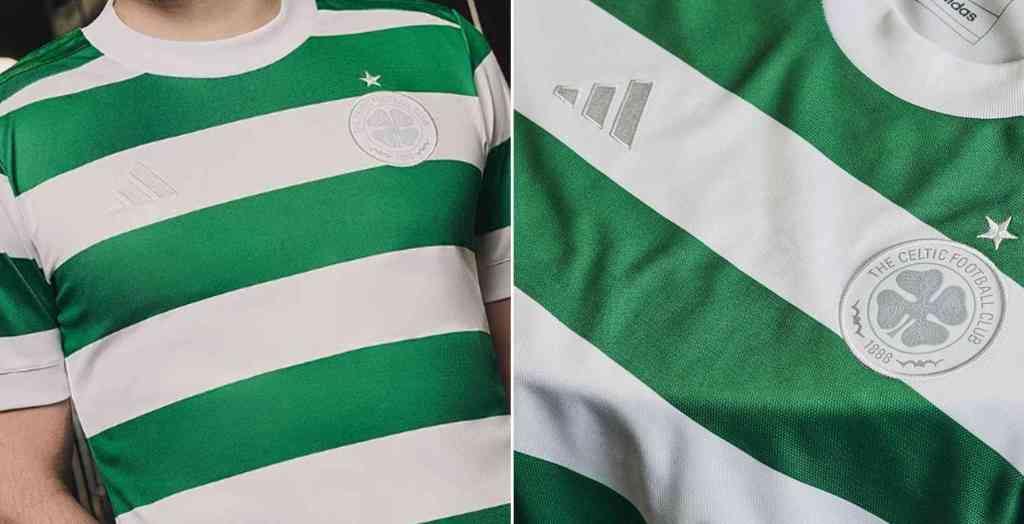
There are football shirts, and then there are relics. The green and white hoops of Celtic are not simply fabric stitched together for sport—they are banners of belonging, woven from threads of faith, defiance, and memory. To wear them is to step into a story that began in 1888, when a club was founded not merely to play football but to serve a community. For the Irish immigrants who had crossed the waters to Glasgow, often facing poverty and prejudice, Celtic was more than a team, it was sanctuary, solidarity, and a declaration of existence.
The hoops themselves, introduced in 1903, became the visual shorthand for that identity. Unlike stripes or blocks, hoops encircle the body, binding chest and heart in a continuous loop. They are unbroken rings, symbols of eternity, of cycles that never end. In Celtic’s case, they became the eternal embrace of a people who refused to be forgotten. Every band of green whispers of Ireland’s fields, every band of white breathes of purity and hope. Together, they form a rhythm that pulses with resilience.
In Glasgow, a city of shipyards and smoke, of hard labour and harder living, the hoops were a beacon. They said: here we are, and here we remain. They carried the weight of immigrant struggle, but also the joy of community triumph. To walk into Paradise, Celtic Park, and see a sea of hoops shimmering in the stands is to witness a congregation, a liturgy of colour. It is football as ritual, football as faith.
The Hoops as Cultural Thread of Glasgow
Glasgow is a city of contrasts: industrial grit and artistic brilliance, sectarian scars and communal laughter. Within this tapestry, Celtic’s hoops are a thread that binds generations. They are not confined to the pitch; they spill into the streets, the pubs, the music, the murals. They are worn by children kicking balls against tenement walls, by pensioners recalling Lisbon in ’67, by workers clocking off from shifts in steel or service.
The hoops are democratic. They belong to no single class, no single era. They are as likely to be seen on a boy in the East End as on a singer on stage, as much a part of Glasgow’s cultural fabric as the Clyde itself. They are stitched into songs sung in smoky bars, into chants that echo across the Gallowgate, into the rhythm of drums on matchday.
And yet, they are not just local. The hoops carry Glasgow outward, across continents. From Donegal to Sydney, Boston to Belfast, the green and white rings are worn by diaspora communities who see in Celtic a mirror of their own journeys. They are a portable homeland, a reminder that identity can be carried in cloth. For many, the hoops are the closest thing to a flag, an emblem of Irish heritage, Scottish belonging, and global solidarity.
In this way, the hoops transcend football. They are cultural shorthand, instantly recognizable, instantly evocative. They speak of Glasgow’s immigrant story, of resilience in the face of exclusion, of joy found in collective triumph. They are the city’s poetry written in cotton and polyester.
The Mythic Power of the Hoops
There is something mythic about the hoops. They are not merely colours; they are archetypes. Green, the colour of renewal, of spring, of life itself. White, the colour of peace, of transcendence, of light breaking through shadow. Together, they form a duality, a balance, a harmony.
When Celtic players step onto the pitch clad in hoops, they are not just athletes, they are actors in a ritual drama. Each pass, each tackle, each goal is performed beneath the gaze of ancestors, beneath the weight of history. The shirt transforms them into symbols, into embodiments of community pride.
Think of Lisbon, 1967. The Lisbon Lions, clad in hoops, conquering Europe not with wealth or glamour but with spirit and skill. That victory was not just a sporting triumph; it was a mythic moment, a declaration that a club born of charity and struggle could rise to the summit of the continent. The hoops became talismanic, proof that identity and belief could overcome odds.
Even in defeat, the hoops carry meaning. They remind supporters that the story is larger than the scoreline. To wear them is to participate in a saga that stretches across decades, across oceans. They are armour against despair, banners of hope.
And in the stands, the hoops multiply. Thousands of bodies clad in green and white, moving as one, singing as one. It is not just spectacle, it is communion. The hoops transform individuals into collective force, into a chorus that reverberates through Glasgow’s streets and far beyond.
The Hoops as Living Legacy
Symbols endure because they are renewed. The hoops are not relics locked in glass; they are living, breathing, worn anew each season, each generation. Children who pull on the shirt today step into a lineage that stretches back more than a century. They inherit not just colours but stories, struggles, songs.
In Glasgow, the hoops are stitched into memory. They are seen in old photographs, in faded scarves, in murals painted on brick. They are passed down like heirlooms, like family traditions. They are worn at weddings and funerals, at christenings and wakes. They accompany life’s milestones, marking identity at every turn.
And they continue to evolve. Modern fabrics, modern sponsors, modern players, but the hoops remain. They are the constant, the heartbeat, the unbroken circle. They remind us that while football changes, while cities change, while generations pass, some symbols endure.
The green and white hoops of Celtic are more than a kit. They are a covenant between club and community, between past and present, between Glasgow and the world. They are the eternal embrace of a people who found in football not just sport but sanctuary, not just competition but communion.
To see them is to feel history’s weight and hope’s light. To wear them is to declare belonging. To sing beneath them is to join a chorus that has never been silenced.
The hoops are not just iconic… they are sacred. They are Glasgow’s poetry, Ireland’s memory, football’s myth. They are the eternal rings that bind a people together, generation after generation, season after season.


Leave a Reply