There are football clubs that exist as sporting institutions, and then there is Celtic. Celtic is not simply a team that plays matches. Celtic is a story, a community, a cultural inheritance passed from generation to generation. It is a club born from poverty, built by immigrants, shaped by struggle and carried forward by a support that has never forgotten where it came from. To understand why players with progressive, left leaning politics resonate so deeply at Celtic, you must first understand that Celtic’s identity is not neutral. It never has been.
Celtic were founded in 1887 to feed the poor. That is not a metaphor. It is a fact. The club was created to raise money for the Irish Catholic community in Glasgow, a community that faced discrimination, exclusion and hardship. Celtic’s earliest supporters were people who knew what it meant to be marginalised. They knew what it meant to fight for dignity. They knew what it meant to stand together when the world refused to stand with them.
That history did not fade. It evolved. It became part of the club’s DNA. Celtic supporters have always carried a sense of solidarity, a sense of anti establishment pride, a sense of connection to global struggles for justice. You see it in the flags. You hear it in the songs. You feel it in the atmosphere. Celtic Park is not a place where politics is an intrusion. It is a place where politics is woven into the fabric of identity.
This does not mean every supporter shares the same views. Celtic is a broad church. There are debates, disagreements and different interpretations of what the club’s political identity means. But the core values remain constant. Anti racism. Anti fascism. Community. Solidarity. A belief that football is more than a game. A belief that a club should stand for something.
In that context, players who express progressive politics do not feel out of place. They feel like they belong. They feel like they are speaking a language the supporters already understand. They feel like they are stepping into a culture that values courage, empathy and conviction.
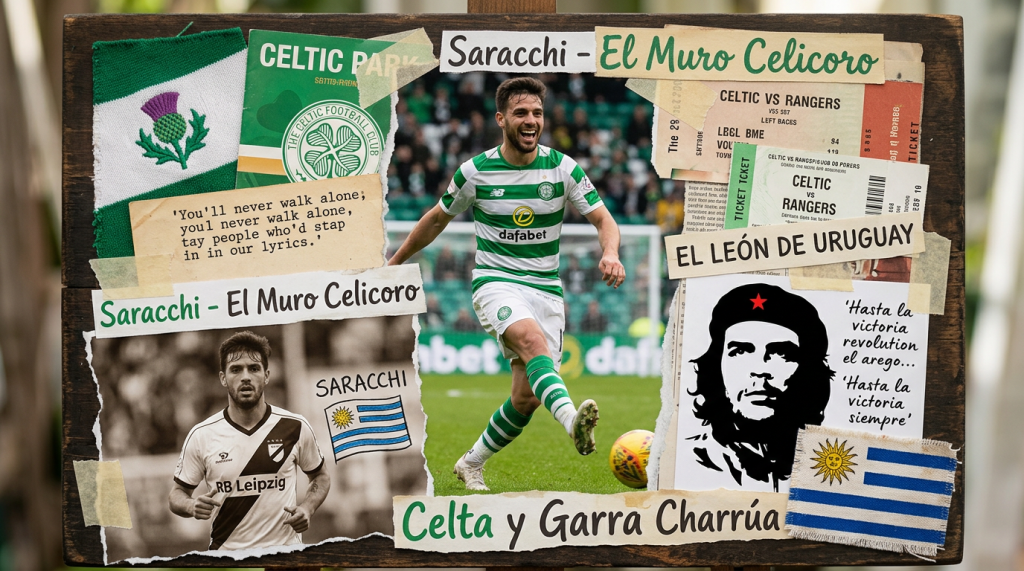
This is the world Marcelo Saracchi walked into. And this is why he fit so naturally into Celtic’s story.
Marcelo Saracchi and the politics of identity
Marcelo Saracchi did not arrive at Celtic as a blank slate. He arrived with a history, a personality and a political identity that had already made headlines. Years before he pulled on the green and white hoops, he posted an image of Che Guevara on social media. It was not a marketing move. It was not a calculated gesture. It was an expression of who he is, shaped by the culture he grew up in.
Saracchi is Uruguayan. That matters. Uruguay is a country where politics is not something distant or abstract. It is part of daily life. It is part of football. It is part of identity. South American players grow up in environments where activism, social justice and political consciousness are normal. They grow up in communities where footballers are expected to speak, to stand, to represent something larger than themselves.
When Saracchi posted that image, it was not a shock to people who understood his background. It was a window into his worldview. A worldview shaped by working class roots, by a culture that values resistance, by a belief in standing up for the underdog. It was a worldview that Celtic supporters recognised instantly.
The reaction among Celtic fans was not outrage. It was connection. It was recognition. It was the sense that here was a player who understood something about the club without needing to be taught. Here was a player who carried himself with the same sense of conviction that Celtic supporters admire. Here was a player who felt like he belonged before he had even kicked a ball.
Martin O’Neill, a man who understands Celtic’s culture better than most, praised Saracchi’s character. He spoke about his personality, his spirit, his willingness to embrace the club. Those comments mattered. They were not about politics alone. They were about identity. They were about the type of person Saracchi is.
Saracchi did not arrive at Celtic as a political symbol. He arrived as a footballer. But he also arrived as someone whose values aligned naturally with the club’s soul. That alignment created an instant bond. It created a sense of belonging. It created the foundation for what he would become at Celtic.
The footballer behind the politics and why he fits Celtic so perfectly
It is easy to focus on Saracchi’s politics, but to understand why he belongs at Celtic, you must understand him as a footballer. Because Saracchi does not fit Celtic only because of his worldview. He fits Celtic because of the way he plays the game.
Saracchi is a left back who plays with fire. He plays with intensity. He plays with a kind of joyful aggression that Celtic supporters adore. He presses relentlessly. He tackles with conviction. He runs as if the pitch is not big enough to contain him. He plays with emotion, but also with intelligence. He knows when to overlap, when to underlap, when to drive forward and when to sit.
His numbers tell part of the story. His pace, his duel success, his progressive carries, his ability to recover quickly and transition from defence to attack. But the numbers do not capture the full picture. The full picture is in the way he moves. The way he celebrates. The way he throws himself into challenges. The way he lifts the crowd with a single burst of energy.
Celtic supporters love players who play with heart. They love players who give everything. They love players who look like they would run through a wall for the badge. Saracchi is that player. He plays with the same intensity that defines Celtic’s greatest full backs. He plays with the same spirit that supporters see in themselves.
Tactically, he fits Celtic’s needs. He thrives in a high tempo system. He is comfortable pushing high up the pitch. He is fearless in one v one situations. He is aggressive in the press. He is brave in possession. He is the type of full back who can turn defence into attack in a heartbeat.
Celtic Way’s tactical analysis highlighted how often Celtic gain by using Saracchi. His ability to break lines, to create overloads, to stretch the pitch, to disrupt opponents. He is not just a defender. He is a weapon.
And that is why he fits Celtic so perfectly. He is not just a political icon. He is a footballer who embodies the club’s style, the club’s energy, the club’s identity. He is a player who feels like he was made for Celtic Park.
Celtic’s long history of embracing politically conscious players
Saracchi is not the first player with progressive politics to find a home at Celtic. He is part of a long tradition. Celtic supporters have always embraced players who express solidarity, who speak about justice, who show empathy and courage. This is not new. It is part of the club’s history.
Celtic’s political identity has always attracted players who understand the weight of the shirt. Players who know that Celtic is more than a football club. Players who feel the connection between the team and the community. Players who understand that wearing the hoops carries cultural significance.
Throughout the decades, Celtic have had players who spoke openly about social issues, who connected with the Irish political identity of the club, who understood the symbolism of the songs and the flags. Players who embraced the club’s roots rather than shying away from them.
Celtic supporters do not demand that every player share their politics. They do not require ideological alignment. What they value is authenticity. They value players who are genuine. Players who care. Players who show respect for the club’s history and the community that supports it.
Saracchi fits that mould. He is not performing. He is not pandering. He is being himself. And Celtic supporters respond to that. They always have.
This is why players like Saracchi feel so natural at Celtic. They are not anomalies. They are part of a pattern. They are part of a tradition. They are part of the club’s story.
The modern era and the rise of players like Julián Araujo
Saracchi is not alone in this modern Celtic story. Julián Araujo is another example of a player whose identity, personality and politics resonate deeply with the support. Araujo is Mexican American, a player who has spoken openly about representation, about identity, about the challenges he has faced. He is a player who carries himself with pride, with resilience, with a sense of community.
Araujo’s journey has not been easy. He has faced criticism, injury setbacks and moments of controversy. But through it all, he has shown courage. He has shown passion. He has shown the type of fire that Celtic supporters love.
When Araujo grabbed his crotch in a flashpoint moment against Rangers, it was not a polished or diplomatic gesture. It was raw emotion. It was the heat of the moment. It was the type of passion that Celtic supporters recognise instantly. They did not condemn him. They embraced him. They saw a player who cared. They saw a player who felt the rivalry. They saw a player who understood the intensity of the fixture.
Araujo’s injury struggles only deepened the connection. Supporters rallied behind him. They admired his resilience. They admired his determination to return. They admired the way he carried himself through adversity.
Araujo, like Saracchi, fits Celtic because he plays with heart. He fits Celtic because he carries himself with authenticity. He fits Celtic because he understands the emotional weight of the shirt.
And he fits Celtic because he represents something larger than football. He represents identity. He represents pride. He represents the type of player who thrives in a club where culture matters.
Why progressive players thrive at Celtic and why they always should
This is the heart of the argument. Players with progressive politics do not thrive at Celtic by accident. They thrive because Celtic is a club built on values that align naturally with progressive worldviews. Solidarity. Community. Anti discrimination. Anti fascism. A belief in standing up for the underdog. A belief in fighting for justice. A belief that football is a platform for expression, not silence.
Players like Saracchi and Araujo understand these values instinctively. They grew up in cultures where politics and football are intertwined. They understand the importance of identity. They understand the importance of community. They understand the importance of standing for something.
Celtic supporters do not demand political conformity. They do not require players to share their views. But they respond to players who show courage. They respond to players who show empathy. They respond to players who show conviction.
Saracchi thrives at Celtic because he is not afraid to express himself. He is not afraid to stand for something. He is not afraid to play with emotion. He is not afraid to be authentic.
Araujo thrives for the same reason. He is not afraid to show who he is. He is not afraid to embrace the culture. He is not afraid to connect with the support.
Celtic is a club where identity matters. Players who understand that identity feel at home. Players who share that identity become icons.
This is why progressive players belong at Celtic. Not because of ideology alone, but because of courage. Because of authenticity. Because of heart.
The future and why Celtic should continue embracing players like Saracchi
Celtic’s identity is a strength. It is a source of pride. It is a source of connection. It is a source of power. In a football world that often tries to sanitise politics, Celtic remain a club that understands the importance of culture. A club that understands the importance of community. A club that understands the importance of standing for something.
Players like Saracchi represent the modern Celtic player. Skilled. Fearless. Politically conscious. Emotionally connected to the support. Players like Araujo represent the same spirit. Players who play with heart. Players who carry themselves with pride. Players who understand the weight of the shirt.
Celtic should continue embracing players like this. Not because of their politics alone, but because of their courage. Because of their authenticity. Because of their ability to thrive in a club where identity matters.
Celtic are more than a football club. They are a community. A culture. A story. Players like Saracchi do not just play for Celtic. They belong to Celtic. They become part of the club’s soul.
And that is why players with progressive politics will always have a place at Celtic. Because Celtic is a club that stands for something. Because Celtic is a club that values courage. Because Celtic is a club that understands that football is not just about goals and trophies. It is about identity. It is about community. It is about heart.
Marcelo Saracchi embodies all of that. And that is why he fits Celtic so beautifully.


Leave a comment