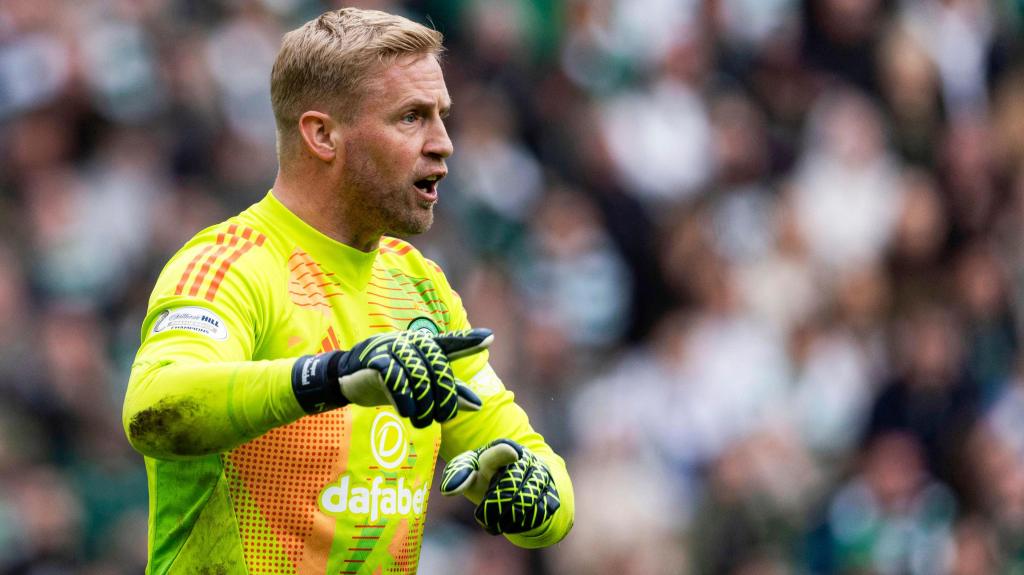
Once a colossus between the posts, now a man buffeted by the Glasgow gale.
Football’s most unforgiving truth is that time always wins. Kasper Schmeichel, Premier League champion, Danish icon, and heir to a famous name, arrived at Celtic to write a final, glowing chapter. But as the 2025/26 season has gathered pace, the narrative has soured. High-profile errors, tactical turbulence, and a public discourse that too often strays into the personal have converged into a stark question: is this the endgame for Kasper at the elite level?
A Triumphant Arrival, a Heavy Burden
When Celtic brought Schmeichel to Glasgow in 2024, it felt both pragmatic and romantic. Here was a serial winner, fresh from an extraordinary career at Leicester City, stepping into the vacancy left by Joe Hart and instantly assuming the aura of a standard-bearer. He even extended his deal into 2026, described as “the easiest contract I’ve ever signed,” cementing the idea that he and Celtic would chase closing-act glory together.
Peter Schmeichel’s public blessing amplified that optimism. The father, himself a legend, spoke often about the emotional pull of watching his son in green and white and trumpeted the fit between Kasper and Celtic’s stage. Those sentiments crystallized around big European nights, where the elder Schmeichel praised Celtic’s mettle and his son’s performances. This family-infused imprimatur raised expectations and added weight; Kasper wasn’t just a signing, he was a statement.
The early returns even fed the fairy tale: clean sheets, silverware in 2024, and the sense of a champion re-centering his craft in a pressure-cooker environment suggested a fitting last act. But football’s orbit turned, and fast.
The Slide: When Mistakes Become a Pattern
Every goalkeeper makes mistakes; the crisis comes when they cluster. Across late 2024 and into 2025, key moments began to accumulate against Schmeichel. A long-range strike for Braga slipped past him in Europe, drawing Chris Sutton’s stinging “shouldn’t be beaten from there,” and sowing seeds of doubt about his positioning and spring. Then came Hampden: a costly Scottish Cup Final error against Aberdeen that re-opened the debate about how many miles were left on the clock.
By winter 2025/26, the critique solidified into a narrative. Flashscore chronicled a string of poor performances: St Mirren’s Jonah Ayunga outmuscling a set-piece, Dundee United’s winner flashing through, and the Glasgow Derby defeat turning cameras toward Schmeichel’s reactions as Rangers sealed a 3–1 turnaround. Sutton again: “had a shocker.” The booing that followed, however unedifying, signaled a tipping point with sections of the support.
Even sympathetic voices conceded the trajectory. Commentary from The Celtic Star captured the balance: yes, decline is visible; no, that does not license personal abuse. The critique was footballing… mobility, reaction windows, command under aerial pressure… but lines were being crossed online about his physique and age.
The Numbers and the Eye Test
Advanced shot-stopping models are scarce in the public Scottish domain, but the composite picture from reporting and match footage tells a consistent story: the reaction saves that once looked routine now appear a fraction late, and low shots to the upright have become higher-variance events. Flashscore’s roundup of the “heavy fire” he’s under threaded specific incidents together: finals, league banana skins, and the Derby, into the image of a goalkeeper fighting the tide.
Context matters. At his Leicester peak, Schmeichel thrived in a compact block that minimized open-space exposures and funneled shots into predictable lanes. Celtic’s shifting identities since 2024, first under Brendan Rodgers, then the ill-fated Wilfried Nancy interlude, and finally a stabilizing Martin O’Neill, have asked different questions of their keeper: sweeping behind a higher line and playing through frantic transitions. Tactical volatility compounds physical decline; it rarely disguises it.
There have been bright spots: spells of clean sheets in 2025, leadership on big European nights, and testimonies about his elite habits in training. Yet the cruel algebra of goalkeeping is that one error can outweigh a dozen quiet interventions. The ledger in 2025/26, as chronicled by media and punditry, is bleeding red.
Tactical Misfit or Personal Decline?
It’s fair to ask how much of this is system versus self. Nancy’s brief, bumpy tenure was characterized, fairly or not, as chaotic, with centre-backs isolated and defensive spacing erratic. A keeper at 39 needs stable pictures: rehearsed triggers, clear lines of responsibility, and reliable distances to manage. Instead, Schmeichel often saw broken-field transitions, second-phase chaos, and unprotected zones between penalty spot and six-yard line. That environment exposes an older keeper’s legs and spring.
But system alibis run only so far. The Glasgow Derby third goal that seeped under him; the cup-final spill; the long-range sighters he once gobbled up… all of these are goalkeeper moments first. Sutton’s public rebukes are neither gospel nor void; they reflect what eyes across the ground perceived. The most generous reading is both/and: an aging keeper caught in suboptimal structures, whose own decline magnifies the worst of those structures.
The Human Cost: Between Critique and Cruelty
One of the season’s uglier subplots has been the drift from performance critique into personal insult. Danish media crossed a line last year with grotesque analogies; Schmeichel’s dignified response, he simply doesn’t read it, was a reminder of the person behind the position. And closer to home, some of the body-shaming online is an embarrassment. Critique the handling, the positioning, the footwork; leave the ad hominem at the door.
Celtic’s own media ecosystem has tried to hold that line. Columns acknowledging decline insist, rightly, that respect remains non-negotiable. You can believe that Kasper shouldn’t be Celtic’s No.1 anymore and still honor the career that brought him here. That’s the standard the best supporters’ cultures uphold.
Dressing Room Gravity vs. Matchday Margins
Inside Lennoxtown, Schmeichel’s professionalism still draws praise. Young keepers and coaches point to the veteran’s meticulous preparation: ice baths, recovery cycles, and a relentless standard in training. Leadership is real currency in a long season. But selection is a meritocracy measured on Saturday, not Tuesday. As the campaign wears on, pressure is building for alternatives, most notably Viljami Sinisalo, to be given a run.
Martin O’Neill’s interim return added nuance. Publicly, he signaled faith in Kasper: experience matters when you’re firefighting. Privately, the recruitment machinery whirred. Reports across the Scottish press and transfer columns painted a consensus: Celtic are actively working on a replacement, whether in January opportunism or a summer reset. Stefan Ortega’s name recurs for a reason.
The Successor Question: What Comes After Kasper?
Succession planning at goalkeeper is delicate; the wrong swing haunts you for years. The rumor mill outlines two broad paths: short-term certainty (a seasoned, high-floor profile like Ortega) or a longer runway with a younger option who can grow into the shirt. Publications tied to Celtic coverage have linked the club with Ortega repeatedly, while other names, Nick Pope, Illan Meslier, Jonas Urbig, Kacper Trelowski, float through the discourse as varying bets on age, cost, and upside.
What’s not in dispute is the strategic intent. Multiple reports state that a new No.1 is a priority ahead of 2026/27 and could even be accelerated if the right window opens this winter. The club’s view of Sinisalo as “not yet” compounds that urgency. For a side defined by relentless domestic standards and the European stage’s demand for margins, goalkeeper stability is non-negotiable.
Legacy vs. Reality
Strip away the noise, and Kasper Schmeichel’s ledger is glittering: Premier League champion, FA Cup winner, national-team stalwart, and a player who, even at Celtic, helped deliver trophies and European nights worth remembering. Those things do not evaporate because a final chapter turned messy.
But football is brutally present-tense. The 2025/26 version of Celtic has different needs than the 2024 edition, and the evidence, piled across league defeats, cup shocks, and derby indignities, points to a gap between what Schmeichel can now provide and what the team requires. Even advocates of his character admit the ground has shifted. The professional thing, for club and player, is to face it squarely.
There is, too, a dignified path forward. Contracts end; icons depart; the club endures. Should Celtic and Schmeichel part at season’s end, it should be with gratitude and clarity, not rancor. And if O’Neill (or his successor) keeps faith through May, then the institution’s responsibility is to build the next wall behind him quickly and well. Both can be true.
The Last Word: Even Giants Fall
Kasper Schmeichel didn’t become a lesser professional overnight. He became, instead, a veteran at the wrong end of football’s most merciless position, in a team searching for its tactical self and in a city where keepers either soar or suffocate. He has earned respect. He may no longer command the box. Both statements can inhabit the same sentence.
For Celtic, the calculus is simple: maximize the run-in, manage the moments, and install the successor with decisiveness. For Kasper, the options are equally clear: one last dance elsewhere, a mentorship arc, or the grace to bow out on his own terms. In any case, the echoes of his career will remain long after the Parkhead discourse moves on. Football is cruel; football is honest. And time, as ever, keeps the cleanest sheet.
Do you think Celtic should stick with Schmeichel until the end of the season, or is it time to make the change now? Share your thoughts below.


Leave a Reply