There are moments in football when a club and a manager meet at exactly the right time, and something sparks. Something unexpected. Something joyful. Something that feels, in hindsight, almost inevitable. Ange Postecoglou’s arrival at Celtic in the summer of 2021 did not feel inevitable at all. It felt chaotic, improvised and uncertain. Yet within months, it became clear that Celtic had stumbled into one of the most transformative appointments in their modern history.
When Postecoglou walked into Celtic Park for the first time, he carried with him a lifetime of being underestimated. He had been dismissed before he had even unpacked his bags. Pundits questioned his pedigree. Commentators wondered aloud if Celtic had lost their minds. Alan Brazil famously scoffed on air, only to apologise later with a mixture of humility and admiration. The early noise was loud, but Ange was louder in his conviction. He had lived this story before. He had been doubted in Australia, doubted in Japan, doubted at every step of a career built on proving people wrong.
His worldview had been shaped long before he ever coached a professional team. It was shaped by migration, by the experience of arriving in Australia as a young boy from Greece, by watching his father work tirelessly to build a life for his family. Ange often spoke about how his father never allowed him to feel sorry for himself. Football was not just a game. It was a way of expressing identity, of showing courage, of refusing to shrink in the face of adversity. That philosophy followed him everywhere. It shaped the Socceroos teams that played with fearless intensity. It shaped the Yokohama F Marinos side that won the J League with a style that dazzled Japan. And it shaped the Celtic team that would soon play with a joy and clarity that supporters had not felt in years.
When he arrived in Glasgow, he did not promise miracles. He promised a team that would play without fear. A team that would attack relentlessly. A team that would entertain. A team that would make supporters proud. He said he wanted to bring excitement back to Celtic Park. He said he wanted to build something that would last. And he said it all with a calm certainty that made you believe him, even if you did not yet understand how he would do it.
Celtic needed that certainty. The club had just endured one of the most painful seasons in its modern history. The ten in a row dream had collapsed. The squad was fractured. The identity was lost. The supporters were disillusioned. Into that environment walked a man who had spent his entire career walking into rooms where people doubted him. He did not flinch. He never does.
This was the beginning of the Postecoglou blueprint. A philosophy built on courage, clarity and conviction. A belief that football should be played with joy. A belief that players should express themselves. A belief that supporters should feel something every time they watch their team. Celtic did not just hire a coach. They hired a worldview.
And that worldview was about to change everything.
Building the machine: how Ange reconstructed Celtic from the ground up
To understand why Celtic worked under Ange Postecoglou, you have to understand what he inherited. The squad he walked into was not just underperforming. It was broken. Key players wanted to leave. The recruitment model had stalled. The dressing room had lost its spark. The football had become predictable and joyless. Celtic were a club in need of a rebuild, not a refresh.
Ange did not tiptoe around the scale of the task. He embraced it. He said Celtic needed a major rebuild, and he meant it. He took control of recruitment in a way few managers had done before him. He did not chase names. He chased profiles. He wanted players who fit his system, players who could play at his tempo, players who could think quickly and act even quicker.
Kyogo Furuhashi arrived from Japan and immediately became the embodiment of Angeball. A pressing forward with intelligence, movement and a smile that lit up the stadium. Jota arrived on loan and brought flair, creativity and a sense of mischief on the wing. Liel Abada arrived as a teenager and played with the fearlessness of someone who had never been told to doubt himself. Reo Hatate arrived with the energy of a player who could run for days. Matt O’Riley arrived with the elegance of a midfielder who saw the game two passes ahead.
Every signing had a purpose. Every signing fit a pattern. Ange had spent years refining his eye for undervalued talent in Japan, and he brought that knowledge to Glasgow. He built a squad that could play his football, not someone else’s. He built a squad that could run, press, rotate and dominate.
But the rebuild was not just about players. It was about culture. Joe Hart spoke openly about how Ange restored belief in the dressing room. Players said training sessions were intense, structured and purposeful. The standards rose. The expectations rose. The energy rose. Celtic began to look like a team again. Not a collection of individuals, but a unit with a shared identity.
The speed of the transformation was astonishing. Within months, Celtic were playing with a clarity that felt almost surreal given the chaos of the previous season. The automatisms were forming. The patterns were emerging. The machine was being built, piece by piece, session by session.
And when it clicked, it clicked beautifully.
The architecture of Angeball: the system that overwhelmed Scotland
Ange Postecoglou’s Celtic did not just win matches. They imposed themselves. They suffocated opponents. They played with a tempo that felt relentless. They played with a structure that felt choreographed yet spontaneous. They played with a joy that made supporters fall in love with football again.
At the heart of the system was an ultra attacking 4-3-3 that averaged more than 65 percent possession. But possession was not the point. Purpose was the point. Celtic moved the ball quickly, vertically and aggressively. They did not pass for the sake of passing. They passed to create space, to manipulate opponents, to force mistakes.
The inverted full backs became the signature of the system. Greg Taylor stepping into midfield to form a box with Callum McGregor. Anthony Ralston doing the same on the opposite side. This created central overloads that allowed Celtic to dominate the middle third. It also allowed the number eights to push higher into the half spaces, where they could combine with the wingers and the striker.
The wingers stayed high and wide, stretching the pitch and forcing defenders into uncomfortable decisions. If they stayed narrow, Celtic played around them. If they stayed wide, Celtic played through them. The number eights arrived late into the box, creating constant overloads. The striker pressed the centre backs from the blind side, forcing rushed clearances and turnovers.
The high press was relentless. Celtic tried to win the ball back instantly, often pressing in a 4-1-4-1 shape. The defensive line pushed high, compressing the pitch and suffocating opponents. The tempo was breathtaking. The movement was constant. The rotations were seamless.
It was football played at full volume. Football that demanded bravery. Football that demanded intelligence. Football that demanded total commitment.
And when it worked, it was irresistible.
The 3-0 win over Rangers in February 2022 became the perfect example. Celtic overwhelmed their rivals with intensity, movement and precision. The crowd roared with every press, every tackle, every transition. It felt like Celtic Park was alive again. It felt like the club had rediscovered its soul.
This was the architecture of Angeball. A system built on courage, clarity and control. A system that turned Celtic into a machine.
Automatisms and intensity: why Celtic overwhelmed the league
If the tactical structure was the skeleton of Angeball, the automatisms were the heartbeat. Celtic did not just play patterns. They lived them. They rehearsed them until they became instinctive. The full back stepping inside. The eight receiving on the half turn. The winger holding width. The striker pressing the centre back’s blind side. These movements were not instructions. They were habits.
The intensity was not just physical. It was psychological. Celtic created a tempo trap that opponents could not escape. Teams arrived at Celtic Park already exhausted by the idea of what was coming. They knew they would be pressed. They knew they would be chased. They knew they would be forced into mistakes. And they knew that once Celtic scored, the floodgates could open.
The fitness levels were extraordinary. Celtic scored late goals with a regularity that felt almost unfair. They surged in the final twenty minutes of matches, overwhelming teams who simply could not keep up. The relentlessness became a trademark. The supporters loved it. The players thrived on it. The league struggled to cope with it.
This was Ange’s gift. He created a team that played with joy, but also with discipline. A team that played with freedom, but also with structure. A team that played with flair, but also with purpose.
Celtic did not just win the league. They dominated it. They controlled it. They reshaped it.
And they did it with a smile.
The European ceiling: why the model struggled to scale
For all the beauty of Angeball, there was a tension at its core. The same principles that made Celtic irresistible in Scotland created vulnerabilities in Europe. The high line that suffocated domestic opponents became a risk against elite forwards. The inverted full backs that created central overloads became exposed in transition. The insistence on playing out under pressure led to turnovers in dangerous areas.
Celtic’s Champions League campaign under Ange was thrilling, but also frustrating. They created chances against Real Madrid, RB Leipzig and Shakhtar Donetsk. They played with courage. They played with identity. But they conceded goals that felt avoidable. They were punished for mistakes that Scottish teams could not exploit.
The squad profile was part of the problem. Ange’s system requires elite defenders who can defend large spaces. It requires midfielders who can resist pressure from world class opponents. It requires forwards who can finish half chances. Celtic had good players, but not the elite level required to execute the system at its highest level.
Ange refused to compromise. He said he would rather fail playing his football than succeed playing someone else’s. It was admirable. It was principled. It was also costly in Europe.
But it was never dull. Celtic played with bravery. They played with personality. They played with joy. And even in defeat, supporters felt proud of the way the team approached the challenge.
The European ceiling was real. But so was the ambition.
The treble and the farewell: Ange’s Celtic at full power
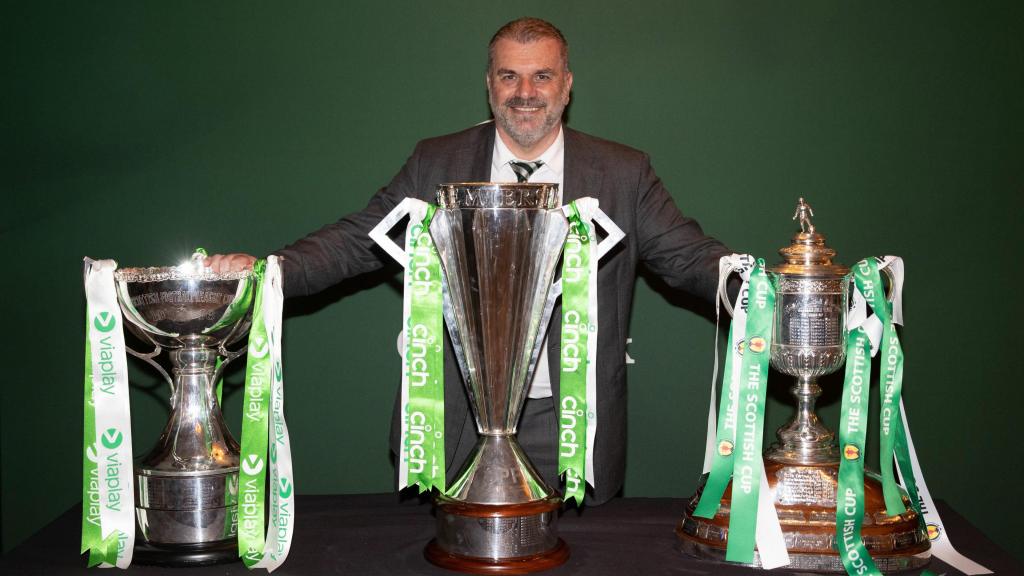
The 2022/23 season became the culmination of everything Ange had built. Celtic played with a confidence that bordered on swagger. They won the League Cup final against Rangers with authority. They controlled the league from start to finish. They sealed the Scottish Cup to complete a treble that felt both inevitable and deserved.
The football was joyous. The atmosphere was electric. The connection between the team and the supporters was stronger than it had been in years. Celtic Park felt alive again. Every match felt like an event. Every goal felt like a celebration of the identity Ange had restored.
Pundits praised him. Players adored him. Supporters trusted him. Chris Sutton said Ange was respected for the job he did. Joe Hart said he loved being a player under him. The admiration was universal.
And then came the farewell.
When Tottenham came calling, Ange faced a decision he had earned. He spoke about ambition, challenge and the desire to test himself at the highest level. He left Celtic with gratitude, pride and a sense of unfinished business. Supporters felt a mixture of disappointment and appreciation. They knew what they had lost. They also knew what they had gained.
Ange left Celtic at full power. He left them with trophies, memories and a blueprint that would shape the club for years.
The long tail: what Ange left behind and what Celtic learned
Ange Postecoglou did not just win trophies at Celtic. He changed the club. He modernised the recruitment model. He rebuilt the training culture. He reconnected the team with the supporters. He proved that Celtic could play proactive, modern football. He raised expectations. He raised standards. He raised the bar.
But he also left challenges. The squad was built for his system, not for universal use. The intensity required constant reinvestment. The European ceiling remained unsolved. The club had to decide whether to continue the blueprint or pivot to something new.
His influence continues to ripple through Celtic Park. The players he signed still carry his imprint. The supporters still sing his name. The club still feels the aftershocks of his departure. And even Tottenham occasionally played with the same courage, the same clarity, the same joy that Celtic once did.
Ange Postecoglou’s Celtic was not just a team. It was a feeling. A reminder that football can be bold, expressive and full of life. A reminder that identity matters. A reminder that joy matters.
He arrived as an outsider. He left as a beloved figure. And he left behind a blueprint that will be studied, debated and admired for years.
Celtic worked under Ange because he made them believe again. He made them dream again. He made them smile again.
And that is a legacy that lasts.


Leave a comment