There are clubs whose names are borne on scarves and billboards, and there are clubs whose names are woven into the fabric of a nation’s story. Celtic Football Club belongs to the latter, an evergreen thread on Scotland’s tapestry, shimmering green and white across decades of triumph, tribulation, and transcendent purpose. To walk up the slope to Paradise, to hear the first warm chorus rise before kick-off, is to step into a living chronicle: a cathedral of memory where football, faith, and community meet.
The Founding Flame
Celtic’s origin is not merely an entry in a ledger but a lantern lit in the winter of need. In 1887, Brother Walfrid, a Marist Brother with sleeves rolled and heart blazing, set a table where football would become bread. The fledgling club was conceived as a charitable enterprise, a remedy for hunger and hardship in Glasgow’s East End, a team whose first victory was compassion. From its earliest breath, Celtic carried a vocation more profound than points or prizes: to bind people together, to give a city’s bruised spirit somewhere to sing.
This birthright shaped everything that followed. The club’s enduring ethos, hospitality to the marginalized, dignity for the working poor, pride in Irish-Scottish heritage, became a compass. Celtic did not merely play games; it hosted gatherings of identity. Within those gatherings, the game learned to tell stories that mattered: about belonging and struggle, about the restorative power of a shared chorus cutting through grey skies.
The Hoops Become a Banner
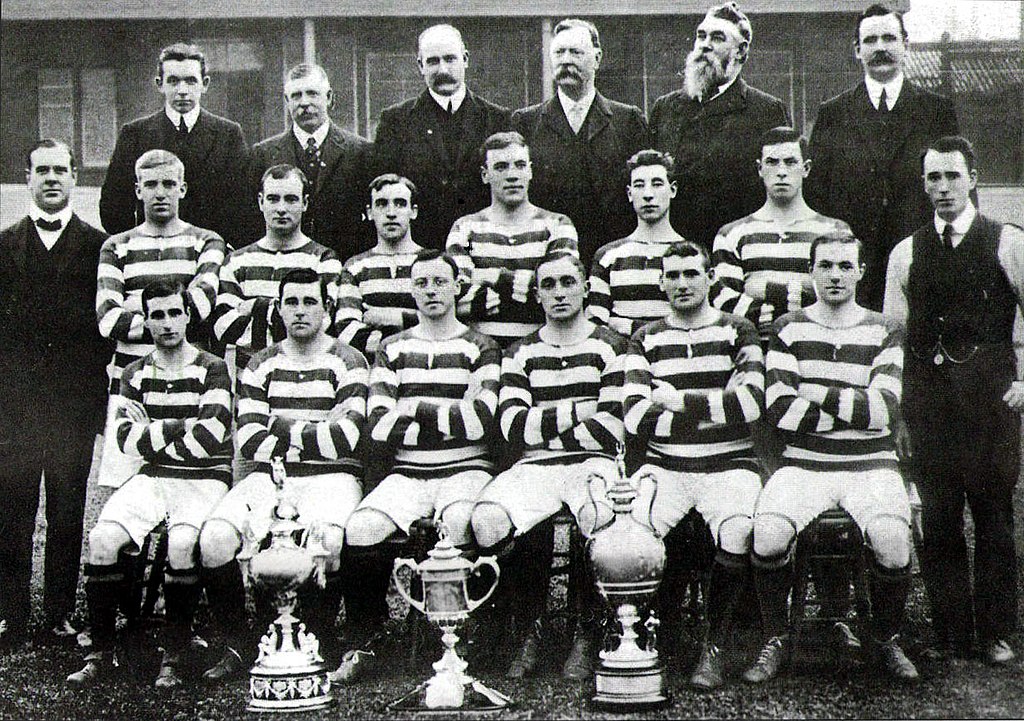
When the green-and-white hoops first encircled Celtic’s chest, they did more than distinguish a strip; they declared a symbol. The hoops are a ring of continuity, an unbroken circle promising return, of seasons, of songs, of hope. Generations saw themselves in those bands: workers leaving shipyards and foundries, families emerging from tenements, children learning the geography of the city by the routes to the ground. As the century turned and turned again, those hoops became a shorthand for steadfastness. More than a colour scheme, they were the club’s vow to remain vivid against the weather of change.
As players ran beneath them, Marathons of endeavour across rain-glossed turf, Celtic cultivated a style that mirrored the strip’s brightness: expansive, adventurous, generous in attack, rooted in the conviction that football could be both honest graft and artistry. When the team sang through a match, it sounded like the crowd: exuberant yet tender, bold yet kind.
Lisbon: A Night That Still Dawns
If Scotland’s footballing soul has a sunrise, it is Lisbon, 1967. The Lisbon Lions did not merely lift a European Cup; they lifted the horizons of Scottish football. In a stadium far from home, wearing those hoops made luminous under Portuguese sun, they faced Inter Milan, the citadel of catenaccio, and threw open a window. Celtic’s victory, authored by homegrown players born within a few miles of the stadium, felt like a parable about possibility. It said that courage could be local, artistry indigenous, glory handcrafted.
What makes Lisbon timeless is not only the silverware but the manner of its attainment: attacking, fluid, fearless football; a performance that grafted joy onto technique. For Scottish football, it was an unarguable proof that excellence could be an export as well as a heritage. It changed what clubs aspired to and what supporters believed possible, reshaping ambitions and rewriting the vocabulary of pride. Decades later, Lisbon remains less a date than a direction: a compass point for the club’s philosophy and an ember that keeps modern cold nights warm.
Rivalry and Reflection: The Furnace of Identity
No account of Celtic’s role in Scotland can ignore the old, unquiet mirror: Rangers. Their rivalry is a furnace in which countless narratives have been tempered, some bright, some troubled, but always consequential. In the theatre of the Old Firm, Celtic helped script the nation’s most watched performance, a spectacle that exposes fibres of culture, religion, class, and politics.
Yet Celtic’s significance here is not merely as a foil but as a moral actor. Time and again, through transitions and storms, the club has chosen to articulate its identity as open-handed and outward-facing, insisting that the roar that fills Paradise must welcome. Rivalry has sharpened standards, raised the floor and ceiling of Scottish football, and compelled improvement, from stadium safety and youth development to broadcasting and governance. In the contest’s heat, Celtic helped forge a more professional domestic game, where excellence is both demanded and displayed.
The Community Mandate
Celtic’s greatest victories are not all scored in minute registers. There is a quieter arithmetic, of meals served, causes supported, projects funded, that shows how a football club can be a civic institution. The charitable spine that Brother Walfrid set has never slipped; it bends toward those who need a lift, a place, a beginning. Through foundations and community initiatives, Celtic has modeled how success can be shared and how heritage can be a service.
In this way, Celtic rewrote the notion of what a club owes its city. The stadium is more than a venue; it is a lighthouse. Supporters do not merely attend; they belong. Families bring children to learn the songs, not as consumers of spectacle, but as apprentices of solidarity. Traditions, like scarves raised in anthem, like tributes for the lost and the brave, teach that football carries rituals which, when kept, keep us.
Style and School: Footballing Thought
Celtic has also been a school of footballing ideas. Managers across eras, each with different grammar, have contributed to Scotland’s tactical vocabulary. From the sweeping width and pressing courage of early sides to modern calibrations of possession, the club helped the domestic game reckon with global trends while retaining a local accent. Youth academies have formed paths for talent and character alike; aspiring players learned not only how to pass, but how to belong.
By competing in Europe, Celtic brought international tests to Scottish soil, raising the standard and sharpening the technique of opponents accustomed to domestic rhythms. Each continental campaign, however it ended, was a translation exercise, teaching Scotland new ways to arrange a midfield, to manage tempo, to suffer wisely and persevere joyfully.
Economy of Emotion and Enterprise
The green tide is an economy: of finance, certainly, but also of feeling. Celtic’s support, faithful, far-traveling, abundant, has been a lifeblood of Scottish football’s marketplace. Turnstiles spin, broadcasters beam, sponsors notice, and the nation’s football rises with the swell. In times lean or lush, Celtic’s crowds have provided a stable heartbeat, underwriting ambition across the league.
But there is a less quantifiable commerce at work: the exchange of stories, the inheritance of belonging. When a grandparent tells a child about Kenny, about Jock, about nights when the whole city seemed to brighten, they transact in memory’s currency. Such storytelling is a national resource. It keeps football from shrinking into results and restores it to meaning.
Paradise as Pilgrimage
Celtic Park is not merely a stadium but a place people go to remember who they are. The walk along London Road, the sudden view of roofline, the first glance at immaculate turf, these are steps in a pilgrimage. Supporters arrive carrying their week like a weight; they leave carrying a song like a lantern. Within those ninety minutes, Celtic gives Scotland an experience of collective joy that feels both ancient and renewably modern.
That experience is instructive. It teaches patience, how to trust a move as it unfolds, and courage, how to press high against fear. It teaches mercy, applause for the honest opponent, and gratitude, the standing ovation for those who gave before us. In teaching these, Celtic becomes more than participant; it becomes pedagogue, shaping how Scotland watches, feels, and speaks about football.
The Future’s Green Horizon
History’s glories are not a museum; they are a promise. Celtic’s role in Scottish football continues to evolve in an era of analytics, global markets, and shifting cultural currents. The club’s task is familiar and fresh: to marry tradition with innovation, to keep Brother Walfrid’s lantern lit while finding new streets to illumine. There are challenges, competition formats, revenue disparities, the gravity of larger leagues, but Celtic’s answer has always started with the people: the supporters whose faith is a renewable energy, the youth whose dreams are curriculum, the city whose needs remain real.
If Lisbon was a sunrise, tomorrow is a horizon, the colour of which will be written by choices made today. Investment in academy excellence, in community programs, in sustainable operations, and in football played bravely will allow Celtic to remain both a local treasure and a global emissary. The club’s greatest gift to Scottish football has never been merely trophies; it has been the insistence that football can carry meaning without losing magic, that a team can be a neighbour without losing nerve.
Coda: The Song That Carries
What, finally, is Celtic’s role in Scottish football history? It is to be a keeper of flame and a singer of songs. It is to remind the nation that the game is a kind of poetry: structured by rules, liberated by imagination, sanctified by community. It is to show that victory, when won with generosity and style, becomes more than a record, it becomes a story worth telling to the next generation.
As another matchday approaches and the terraces prepare their thousand-throated hymn, consider the long arc: a club born of need, matured in rivalry, crowned in European sun, anchored in charity, and ever turning its face to the future. Celtic has been, and remains, a garden in which Scottish football has found colour, courage, and companionship. The hoops do not merely circle a chest; they encircle a people. And in that embrace, a nation’s game has learned, again and again, how to breathe.


Leave a Reply