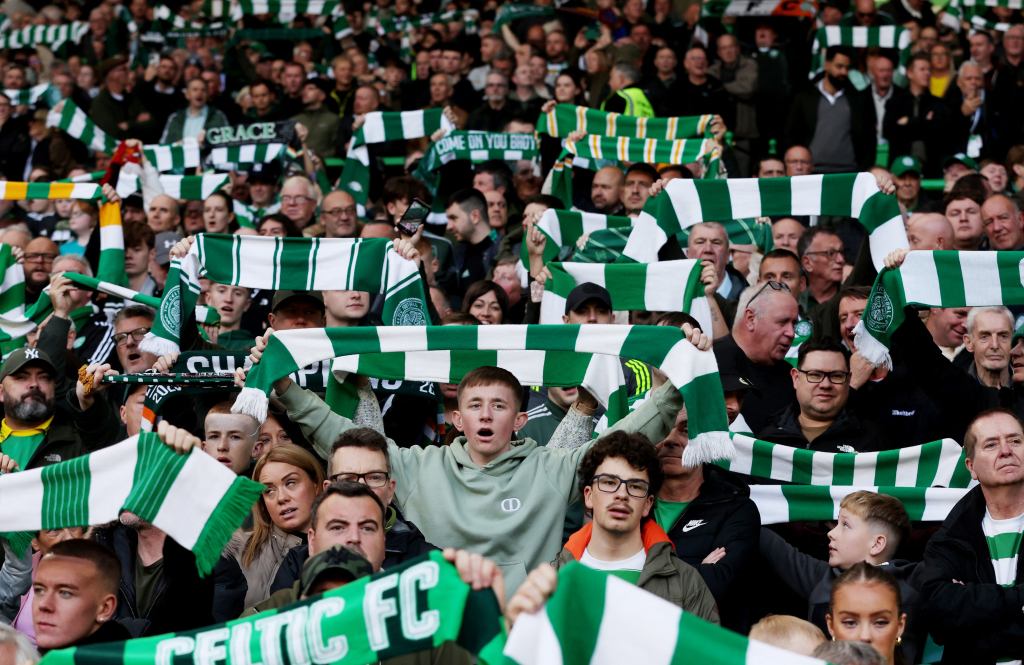
There are moments at Celtic Park when the game pauses, not in silence, but in song. A thousand voices swell into one, and the stadium becomes a choir loft, its rafters trembling with melody. These are not mere chants; they are hymns of heritage, ballads of belonging, anthems that braid past and present into a single, soaring note. To understand Celtic is to understand its music, for the club’s soul is scored in green and white staves.
The First Note: A Club Born Singing
From its inception in 1887, Celtic was a club of community, and communities sing. In the East End of Glasgow, where hardship pressed heavy, music was a buoy, a way to rise above soot and sorrow. Irish immigrants brought their ballads across the sea, songs of exile and endurance, and these melodies found new verses in Scotland’s industrial heart. When Celtic took the field, the terraces became a stage for these inherited harmonies, and football became a festival of sound.
You’ll Never Walk Alone: A Hymn of Hope
Though borrowed from Liverpool’s canon, You’ll Never Walk Alone has become a Celtic sacrament. Its lyrics, lifted from Rodgers and Hammerstein’s musical Carousel, speak of storms endured and skies cleared, a metaphor that resonates with a club born to shelter the vulnerable. Sung before kick-off, it is less a performance than a pledge: that no player, no supporter, no soul will face the dark alone. When the chorus crests, Walk on, walk on, with hope in your heart… it feels like a benediction, a green tide washing fear from the field.
The Fields of Athenry: Memory in Melody
If You’ll Never Walk Alone is a hymn, The Fields of Athenry is an elegy. Its verses recall famine and flight, the ache of separation, the stubborn root of love. For Celtic supporters, singing this ballad is an act of remembrance, a way to honour ancestors whose hunger carved the club’s first cause. When thousands lift its lament into the Glasgow air, history becomes audible; the terraces turn into a time machine, carrying voices back to fields where hope once starved but never died.
The Celtic Song: A Banner in Brass
Composed by Glen Daly in the 1960s, The Celtic Song is the club’s own anthem, a jaunty march that greets the team like a green carpet. Its lyrics are simple, its rhythm infectious, its spirit irrepressible: Sure it’s a grand old team to play for, and it’s a grand old team to see. This is not poetry for the library; it is poetry for the lungs, designed to be shouted with joy. When it rings out before kick-off, it feels like a trumpet blast announcing a feast.
Grace and Gallows Humour: The Terrace Chants
Beyond the official anthems lies a wild garden of chants—improvised, irreverent, ingenious. These are the songs that bloom in the heat of rivalry, that turn wit into weapon and laughter into shield. They are Celtic’s folk music: oral, mutable, democratic. Some celebrate heroes, Henrik Larsson, Scott Brown, while others lampoon foes with a mischief as sharp as broken glass. In these chants, the crowd becomes composer, and the melody is minted in real time, proof that football is not only watched but written by its witnesses.
Why We Sing: The Theology of Noise
What is the meaning of these songs? Why do thousands lift their voices in unison, even when the scoreboard sags? The answer is older than football: singing is solidarity. It is the sound of many becoming one, of isolation dissolving into chorus. For Celtic, whose birth was an act of communal mercy, this unity is not ornamental; it is essential. Each chant is a bridge, each anthem a rope binding past to present, stranger to stranger, hope to heartbeat. In song, Celtic remembers what it was made for: to gather, to give, to gladden.
Paradise as Choir Loft
On matchday, Celtic Park is not merely a stadium; it is a sanctuary of sound. The green tide rises in waves of melody, and for ninety minutes, the ordinary laws of loneliness are suspended. Here, a labourer and a lawyer sing the same line; here, grief and gladness harmonize. The songs do not erase hardship, but they transfigure it—turning struggle into strength, memory into music. When the final whistle blows and the last refrain fades, the listener leaves lighter, carrying a tune like a talisman against the week ahead.
The Future of the Songbook
Will these anthems endure? Will new chants join the canon? The answer is yes, for as long as Celtic breathes, it will sing. Technology may change the way we watch, but it cannot mute the need to belong, nor the instinct to express that belonging in sound. Perhaps future terraces will hum with hybrid hymns, old ballads remixed with modern beats, but the essence will remain: voices raised, hearts lifted, hope harmonized.
The Last Verse Never Ends
In the end, Celtic’s songs are not accessories; they are arteries. They carry lifeblood from generation to generation, ensuring that the club’s pulse never falters. To hear them is to hear history humming, to feel heritage vibrating in the ribs. They are proof that football, at its best, is not a contest but a communion, a gathering where the game is only the pretext for something deeper: the making of music, the weaving of we, the echo of eternity in a single, swelling note.
So next time you stand in Paradise and the first line of You’ll Never Walk Alone unfurls like a banner of sound, do not merely listen. Join. For in that joining, you become part of a choir that began before you were born and will continue long after you are gone, a choir whose song is the heartbeat of Celtic, and whose melody is the meaning of home.


Leave a comment