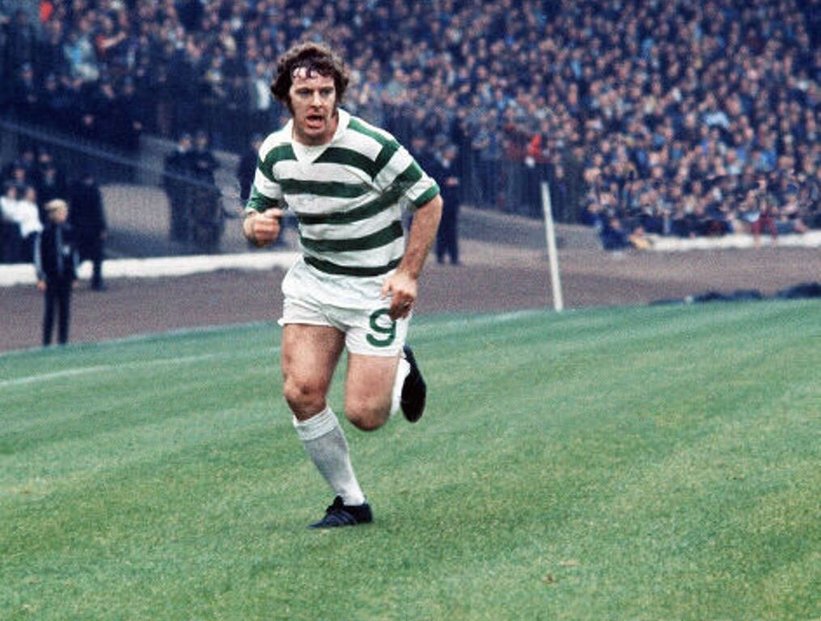
Paradise stands still tonight, its floodlights glowing like candles in a cathedral of memory. The name on every lip is Dixie Deans, a striker whose story is stitched into Celtic’s tapestry with threads of audacity and grace. Born in Glasgow, raised in the hum of Lanarkshire streets, Deans was never just a footballer; he was a phenomenon in green and white. His goals were not mere numbers… they were thunderclaps, shaking terraces and sending songs soaring into the sky.
Think of the hat-tricks, the six-goal symphony against Partick Thistle in 1973, a feat that still echoes through the annals of Scottish football. Think of the European nights, when Deans carried Celtic’s hopes like a torch into foreign arenas. He was a striker of instinct, a predator in the box, a man whose boots spoke in exclamation marks. And though time has claimed his mortal frame, his legend remains immortal, etched in the roar of Paradise, in the rhythm of chants that will never fade.
Tonight, we do not mourn alone; we celebrate a life that made football feel like folklore. Dixie Deans does not vanish, he migrates from flesh to myth, from pitch to eternity. Somewhere beyond the final whistle, in that great green field of stars, Dixie is still scoring, and the crowd… oh, the crowd… still roars.
Early Life and Rise
John “Dixie” Deans was born on 30 July 1946 in Johnstone, Renfrewshire, a town where football was more than pastime; it was a pulse running through the streets. From his earliest days, the game seemed to cling to him like a second skin, shaping a boyhood steeped in anticipation and instinct.
Deans began his senior career with Albion Rovers, where his hunger for goals quickly became legend. In the rugged arenas of the lower leagues, he learned the craft of the poacher, the art of anticipation, the courage to strike where others hesitated. His exploits earned him a move to Motherwell, where he sharpened his edge against top-flight defenders and proved that his scoring touch could thrive under brighter lights. At Fir Park, Deans matured into a striker of menace and mastery, a forward whose name began to ripple beyond Lanarkshire.
By October 1971, Jock Stein saw what others had glimpsed: a predator destined for Paradise. Celtic signed Deans for £17,500, a modest sum for a man who would carve his name into club folklore. It was a transfer that mattered, not just for the goals he would bring, but for the spirit he embodied: fearless, instinctive, and utterly devoted to the cause. From Johnstone’s streets to the grandeur of Celtic Park, Dixie Deans had crossed the threshold, and the roar of the terraces would never forget his name.
Celtic Career Highlights
When Dixie Deans crossed the threshold into Paradise in October 1971, few could have predicted the thunderclaps of glory that would follow. Signed by Jock Stein for £17,500, Deans became a striker of legend, a poacher with a predator’s instinct and a heart that beat in green and white.
His Celtic story is punctuated by feats that shimmer in the annals of Scottish football. None brighter than November 1973, when Deans scored six goals in a single match against Partick Thistle, a record that still stands as a monument to audacity. It was not just a performance; it was a symphony of ruthlessness, each strike a stanza in a poem written on the turf of Paradise.
Deans thrived in the pressure of big occasions. He delivered in Scottish Cup finals, etched his name into League triumphs, and carried Celtic’s banner into Europe with courage and craft. His hat-tricks became folklore, his penalty-box presence a terror to defenders. In total, Deans scored 125 goals in 186 appearances for Celtic, a ratio that speaks not only of quantity but of quality, of a striker whose boots were tuned to the rhythm of glory.
And yet, beyond the numbers, there was theatre. The roar when Dixie struck, the surge of scarves in the terraces, the sense that something elemental had happened… that was his gift to Celtic. He was not merely a scorer; he was a storyteller, and his tales were told in goals.
European Adventures and Near Misses
Europe was a stage where Celtic’s dreams danced with destiny, and Dixie Deans strode into that theatre with courage blazing in his boots. The early 1970s were years of ambition, when Jock Stein’s men sought to reclaim the continental crown they had worn so proudly in ’67. Deans, fierce and fearless, carried those hopes into foreign arenas, his instincts sharpened for nights when the stakes were sky-high.
Yet Europe is a land of triumph and tragedy, and Dixie knew both. None more haunting than that spring evening in 1972, under the floodlights of Parkhead, when Celtic faced Inter Milan in the European Cup semi-final. Ninety minutes of toil gave way to the cruel lottery of penalties. Deans, the predator, stepped forward… a man who had scored for fun, now asked to score for history. His strike sailed high, heartbreak arcing through the Glasgow night. Paradise fell silent, and the dream dissolved like mist.
But legends are not measured by perfection; they are forged in fire and flaw alike. Dixie bore that wound with grace, his resilience a testament to character. He returned to the domestic stage undiminished, his goals flowing like green rivers, his spirit unbroken. Europe had tested him, and though fate denied him glory, it could not dim the light of his legend. For in the story of Celtic, even the near misses shimmer with meaning, and Dixie’s name is etched there… bold, eternal, unforgettable.
The Character Behind the Goals
Numbers tell a story, but they do not tell the man. Dixie Deans was more than a striker; he was a soul stitched into the fabric of Celtic life. Behind the thunder of his goals lay a warmth that disarmed even the fiercest rivalries. He was a man of laughter, a raconteur in dressing rooms, a friend whose wit could turn tension into camaraderie.
Born of working-class grit, Dixie carried humility like a badge. Fame never bent his spine nor dulled his humanity. He spoke to fans as equals, shook hands with strangers as if greeting old friends. In an age before celebrity walls, he walked among the people, one of them, yet somehow more.
Teammates recall his generosity, his refusal to let glory isolate him. He was the heartbeat of banter, the architect of joy, a man who understood that football was not just a game but a communion. And when the boots were hung and the roar faded, Dixie remained what he had always been: a son of Scotland, a servant of Celtic, and a gentleman whose legend was gilded not only by goals, but by grace.
Legacy and Cultural Footprint
Time may soften the roar of terraces, but it cannot silence the name of Dixie Deans. His story lingers like incense in the cathedral of Celtic Park, rising with every chant, every scarf lifted to the sky. For those who watched him play, he was a force of nature; for those who came after, he is a myth that breathes through memory.
Deans’ feats are not confined to record books, they live in the rhythm of pub ballads, in the laughter of old supporters swapping tales of six-goal symphonies and hat-trick heroics. His name is etched into the lexicon of Celtic folklore, spoken with reverence alongside giants like McGrory and Larsson. He was a bridge between eras, a striker who carried the flame of Stein’s empire into a new dawn.
Even now, in the digital age of highlights and hashtags, Dixie’s legend resists reduction. It is not pixels but poetry, not statistics but spirit. Every time Celtic score and the crowd erupts, a fragment of Dixie’s soul is there, woven into the roar, stitched into the song. His legacy is not a relic; it is a living pulse, beating in green and white, eternal as Paradise itself.
Farewell in Green and White
And so, the curtain falls, but not in silence. Paradise hums tonight with a hymn of gratitude, a chorus for the man who turned goals into gospel. Dixie Deans does not leave us; he lingers in the echo of every cheer, in the rhythm of every chant that rolls across the terraces like a tide of devotion.
We picture him now, beyond the reach of time, lacing his boots on a field where the grass is eternal and the sky wears Celtic green. The roar is still there.. oh, the roar… as scarves rise like banners of memory and voices fuse into one immortal song. For legends do not die; they migrate from flesh to folklore, from the fleeting to the forever.
Goodnight, Dixie. The gates of Paradise will never close to you. Your story is stitched into its soul, your name carved into its anthem. And when the ball ripples the net and the crowd erupts, somewhere in that great green beyond, you will smile… and score again.


Leave a Reply