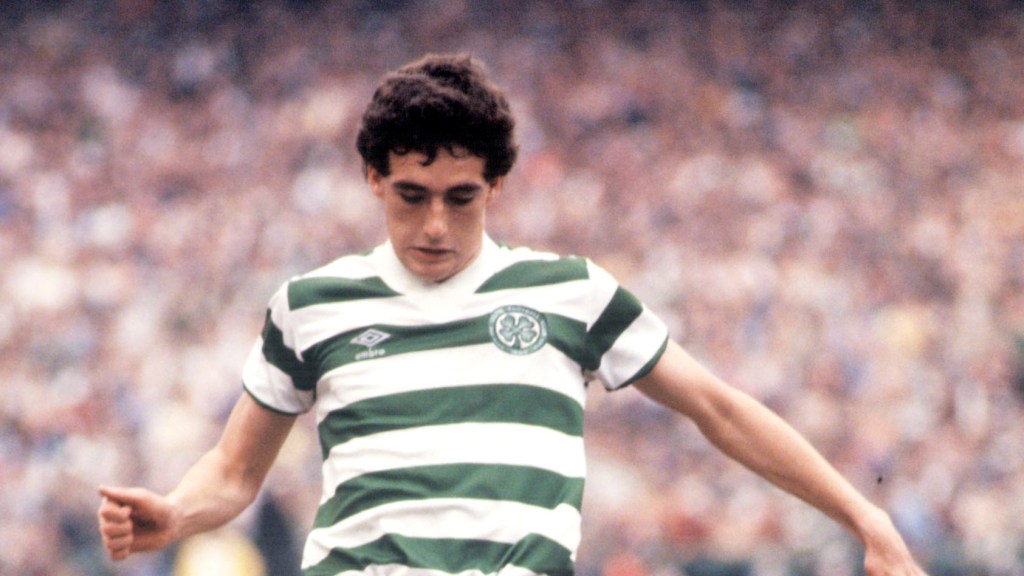
Hampden Park, May 27th, 1995. The rain falls like silver threads, stitching together a tapestry of green and white. In the centre of the pitch stands Paul McStay… Celtic’s captain, the Maestro… lifting the Scottish Cup high above his head. Around him, teammates erupt in joy, but McStay’s celebration is measured, almost reverent. This was not just a trophy; it was a reprieve, a promise that the club he had carried through lean years could still bloom.
Behind the smile lies decades of devotion: 678 appearances, three league titles, four Scottish Cups, and a loyalty that never wavered. In that moment, the roar of Paradise echoes across Hampden, and McStay, faithful through and through, becomes more than a player. He becomes a parable of endurance, a lantern in Celtic’s darkest corridors, a captain whose quiet thunder still rolls through the annals of Scottish football.
Origins and Early Promise
Before the Maestro wore the hoops, he was a boy with a ball and a dream stitched into his boots. Born on 22 October 1964 in Hamilton, Paul McStay grew up in a family where football was not pastime but patrimony. His great-uncles, Jimmy and Willie McStay, had captained Celtic decades earlier, and that lineage hummed like a low chord beneath his childhood. The game was in his blood, but destiny still needed a debut.
That debut came early and emphatically. In June 1980, at just fifteen, McStay captained Scotland’s schoolboys against England at Wembley. The stage was vast, the stakes symbolic, yet the teenager played as if the grass were his own back garden. He scored twice, earned Man of the Match honours, and left the English press blinking at a name they would learn to fear. It was a prophecy in boots: a glimpse of grace that would one day steady Celtic through tempests.
From the Celtic Boys Club, McStay stepped into the senior side with the quiet confidence of a craftsman. His first-team debut arrived on 23 January 1982, a Scottish Cup tie against Queen of the South. Celtic won 4–0, and the boy from Hamilton began to carve his signature on the club’s ledger. A week later, in his league debut at Pittodrie against Aberdeen, he scored the clincher—a goal that felt less like punctuation and more like an opening line.
These were not isolated sparks; they were the first notes of a symphony. McStay’s early years coincided with a turbulent era for Scottish football, the rise of the New Firm, the shifting tides of dominance, but even in that storm, his composure glowed. He was not a player who chased chaos; he orchestrated calm. Every pass was a sentence, every movement a metaphor, and the terraces began to murmur a name that would soon become a mantra: The Maestro.
The Competitive Landscape He Entered
When Paul McStay first laced his boots for Celtic in the early 1980s, the Scottish game was a furnace of rivalries and rising powers. The Old Firm still roared, but the era was not theirs alone. Aberdeen, under the iron genius of Alex Ferguson, and Dundee United, marshaled by Jim McLean, had forged a new duopoly, the “New Firm,” and they were hungry for silver. Between 1980 and 1986, these northern challengers stormed the citadel, claiming league titles and European scalps, forcing Celtic to fight not only for glory but for relevance.
This was no gentle introduction for a teenager with a poet’s touch. McStay stepped into a league where margins were razor-thin, where Pittodrie and Tannadice were fortresses, and where Rangers were stirring toward their own renaissance. Every pass he played was against the backdrop of a shifting hierarchy, every victory a rebuttal to whispers of decline. In such a climate, loyalty was not easy, and leadership was not ornamental, it was essential. McStay’s calm amid the turbulence became Celtic’s compass, a steady hand guiding the club through an era when Scottish football was as fierce as its winter winds.
Style of Play: Why “The Maestro”
To watch Paul McStay in his prime was to witness football as calligraphy, every pass a stroke, every movement a flourish. He was not a player who chased chaos; he composed calm. In an era when Scottish football often roared with raw power, McStay whispered with precision. His vision stretched like green horizons, seeing spaces before they existed, threading passes that felt preordained. He played with a serenity that belied the storm around him, a metronome in a maelstrom.
The nickname “The Maestro” was no accident. It spoke to his orchestral influence, dictating tempo, conducting transitions, turning midfield into a stage for artistry. His first touch was velvet, his distribution surgical, his balance almost balletic. McStay could pivot under pressure and still deliver a pass that split a defence like dawn splitting night. He was not flamboyant for its own sake; his elegance was functional, his beauty born of clarity.
Leadership was woven into his style. He did not bark orders; he led by example, by the quiet authority of excellence. In the lean years of the early ’90s, when Celtic staggered under financial strain and Rangers surged, McStay remained the axis around which hope revolved. Every time he pulled the ball from the mud and made it sing, the terraces remembered why they believed.
Statistics confirm what the eye adored: over 675 appearances, 72 goals, and countless assists that rewrote matches without rewriting headlines. But numbers cannot measure grace. For that, you need memory, the image of McStay gliding across Paradise, head up, heart steady, turning a game into a sonnet.
Loyalty During Lean Years
If greatness is measured only in medals, Paul McStay’s story would seem modest beside the gilded chronicles of others. But true greatness often blooms in barren soil. The early 1990s were Celtic’s winter, financial strain biting deep, Rangers surging toward their nine-in-a-row, and Paradise echoing with questions rather than triumphs. It was a time when temptation whispered from abroad; Italian giants reportedly circled, offering riches and glory. Yet McStay stayed.
He stayed when trophies were scarce and headlines harsh. He stayed when the club he loved seemed to stagger under its own history. For seven years as captain, he bore the weight of expectation like a lantern in a storm, guiding Celtic through corridors of uncertainty with grace and grit. His loyalty was not passive; it was active, a choice renewed every season, every contract, every kick. In an era when football’s compass spun toward money, McStay pointed to meaning.
That fidelity became his finest medal. It told supporters that Celtic was not merely a brand but a bond, not just a club but a covenant. And when the Scottish Cup returned to green hands in 1995, it felt less like a victory and more like vindication, a reward for a captain who had kept faith when faith was hardest to hold.
Numbers That Tell the Story
Behind the poetry of Paul McStay’s play lies a ledger of hard facts, a testament in figures to a career defined by consistency and class.
- Club Appearances: 678 competitive matches for Celtic across all competitions, a span stretching from 1982 to 1997.
- Goals Scored: 72, many from midfield, each a punctuation mark in a narrative of elegance.
- Captaincy: 7 years wearing the armband, guiding Celtic through triumph and turbulence.
- Major Honours:
- 3 Scottish League Titles (1981–82, 1985–86, 1987–88)
- 4 Scottish Cups (1985, 1988, 1989, 1995)
- 1 League Cup (1982–83)
- Individual Awards:
- Scottish Young Player of the Year (1983)
- SPFA Players’ Player of the Year (1988)
- Scottish Football Writers’ Player of the Year (1988)
- International Record:
- 76 caps for Scotland, 9 goals
- Featured in World Cups (1986, 1990) and Euro 1992
- Captained Scotland at every level, including the U-18 side that won the 1982 European Championship, Scotland’s only major trophy at any level.
These numbers do not merely quantify a career; they qualify a legacy. They speak of endurance, excellence, and a loyalty that statistics cannot fully measure, but which every Celtic supporter feels in their bones.
Injury and Retirement: The Final Whistle
For fifteen years, Paul McStay seemed indestructible, a constant in Celtic’s shifting fortunes, a figure as enduring as the hoops themselves. But even maestros are mortal. By the mid-1990s, a persistent ankle injury began to whisper what no supporter wanted to hear: the end was near. Stress fractures and chronic pain turned training into trial, and matches into measured gambles. McStay fought the decline with the same quiet courage that had defined his career, but the body that had carried so much grace could no longer bear the weight of expectation.
On May 1997, at just 32, McStay announced his retirement. There was no grand farewell tour, no blaze of glory, only a dignified bow from the stage he had graced since boyhood. His testimonial, played against Manchester United in December 1995, had already felt like a living eulogy: 37,000 voices rising in gratitude, Sir Alex Ferguson breaking his own rule to honour a player whose loyalty transcended rivalry. When the final whistle blew on McStay’s career, it was not silence that followed, but song, a chorus of memory echoing through Paradise, reminding all who heard that greatness is not measured in years, but in the fidelity of a heart that never strayed.
Cultural Footprint and Legacy
Paul McStay’s influence was never confined to the chalk lines of the pitch; it seeped into the marrow of Celtic’s identity and the wider Scottish game. He was not just a player, he was a symbol. In an era when loyalty began to erode under the acid of commercialism, McStay stood immovable, a green pillar in a shifting world. His name became shorthand for integrity, his presence a reassurance that Celtic’s soul was intact.
Recognition followed, not as fleeting applause but as institutional memory. In 2002, supporters voted him into the Greatest Ever Celtic XI, a pantheon reserved for immortals. In 2010, the Scottish Football Hall of Fame enshrined him among the nation’s finest, affirming what fans had long known: McStay was more than a midfielder; he was a moral compass for the sport.
His family roots deepened the mythos, great-uncles Jimmy and Willie McStay had captained Celtic decades earlier, and his brother Willie wore the hoops too. This dynasty made Paul’s loyalty feel less like a choice and more like a calling, a generational vow renewed with every pass.
Even today, his name surfaces in conversations about what football should be: a craft, a covenant, a community. For Celtic supporters, McStay is not a memory but a measure, a yardstick of grace and fidelity against which all captains are weighed. In the green hush of Paradise, his echo lingers, reminding us that greatness is not only what you win, but what you refuse to abandon.
Faithful Through and Through
When the story of Celtic is told in centuries rather than seasons, Paul McStay will remain a chapter written in bold green ink. His career was not a tale of chasing riches or collecting medals in distant lands; it was a testament to loyalty, leadership, and love for a club that shaped him as much as he shaped it. In an age when football began to tilt toward commerce, McStay stood as a counterpoint… a player who proved that meaning matters more than money, that roots can run deeper than ambition.
He was the Maestro, yes, but more than that, he was the moral compass of Celtic through years of triumph and turbulence. His passes were poetry, his presence a promise, his fidelity a flame that never flickered. For fifteen years, he carried the weight of expectation with grace, and when the final whistle blew on his career, it left an echo that still hums through Paradise.
Greatness is not always gilded; sometimes it is quiet, steadfast, and green. Paul McStay was all of these. Faithful through and through… then, now, and forever.


Leave a Reply