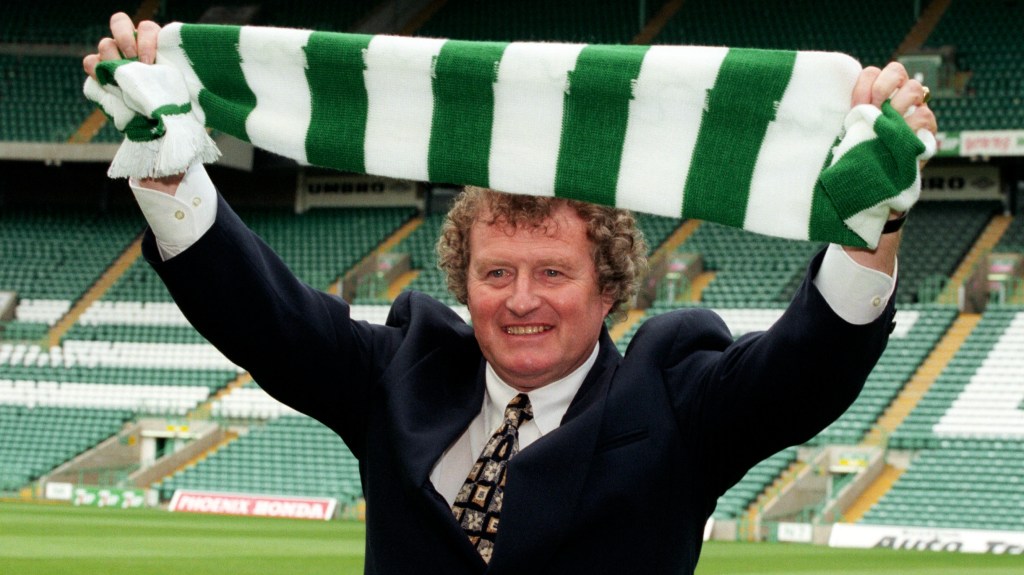
Some managers shout their legend; Wim Jansen whispered it.
In one, single, beautiful season, he lifted Celtic from doubt to deliverance: a League Cup, a league title to stop Rangers’ ten‑in‑a‑row, and, perhaps the most transformative act of all, the signing of a certain Henrik Larsson. The impact of that year wasn’t merely silver; it was identity, restored.
When Jansen arrived in July 1997, he wasn’t a name familiar to the terraces of Glasgow. He was a Dutch master craftsman whose playing career had already brushed against Celtic’s history, European Cup winner with Feyenoord in 1970 after beating Celtic, and whose managerial ethos prized structure, courage, and clarity. He became Celtic’s first continental head coach, operating within a new structure under general manager Jock Brown, and within weeks the task before him was mythic: halt Rangers’ drive for ten‑in‑a‑row.
“Wim Jansen… stopped Rangers’ bid for 10‑in‑a‑row, won the League Cup, and brought Henrik Larsson to Celtic.”
The Celtic Wiki
He didn’t posture; he planned. And in the face of a country expecting a blue coronation, he began a rebuild that felt more like repairing a cathedral than buying a squad: Marc Rieper, Craig Burley, Paul Lambert, Jonathan Gould, smart, role‑fit pieces, and one signing that changed the club’s trajectory for a generation.
Henrik Larsson: The Signature That Became a Signature Tune
There are transfers, and then there is Larsson for £650,000 from Feyenoord on 25 July 1997, a price that today reads like a typo. Jansen’s insight and Celtic’s urgency combined to deliver the greatest foreign import Scotland has likely ever seen. The Swede’s debut had a famous miscue at Easter Road, a pass intercepted by Chic Charnley, but the story that followed needs no embellishment: goals, leadership, devotion to the shirt, and the re‑enchantment of Paradise.
Larsson’s first season would end with 19 goals, culminating in a thunderous 25‑yard strike on the final day; in time, he would become “King of Kings,” score 242 goals, and carry Celtic back onto Europe’s grand stages. But the first step… the moment of faith… belonged to Jansen.
A Season That Began in Turmoil and Ended in Deliverance
Celtic lost their first two league matches (Hibs away, Dunfermline at home). Rangers were charged up, the nine‑in‑a‑row weight hanging over the city. And yet Jansen’s Celtic did not panic. The team settled. The signings aligned. The League Cup arrived, a 3–0 win over Dundee United at Ibrox, proving to a bruised support that silver was possible again.
January brought a natal turning point: Celtic 2–0 Rangers on New Year’s Day, an emotional anchor that aligned belief with mathematics. By spring, the title race narrowed to the point of breath. On 9 May 1998, Celtic beat St Johnstone 2–0 (Larsson, Brattbakk) while Rangers won elsewhere; anything but three points would have handed history to their rivals. Celtic did not blink. The ten was stopped; the nine remained sacred.
Statistics add resonance to the poetry: Celtic finished two points clear, conceded just 24 league goals, and reversed momentum that had felt structural. Even neutral round‑ups underline that Jansen’s single season rebalanced the rivalry after years of dominance.
How He Changed Celtic: Beyond the Trophy Cabinet
He rebuilt the spine with clarity, not spectacle.
Burley’s engine, Lambert’s European composure, Rieper’s assurance, Gould’s certainty, signings that turned noise into cohesion. Jansen’s Celtic wasn’t simply a list of names; it was a team with roles.
He restored Celtic’s European pulse.
Celtic’s tie with Liverpool in the UEFA Cup didn’t yield progression, but it reintroduced Celtic to modern continental rhythms, a first credible step in years. Supporters called it ‘the first good European performances in around five years.’ That matters, even in defeat, because it signalled relevance.
He reconnected football to the crowd’s sense of self.
Celtic had endured a decade of seeing another’s parade. Jansen’s side rediscovered the grammar of Celtic football: brave passing, disciplined pressing, and a refusal to be intimidated by the inevitability narrative. The restored title wasn’t just a win; it was a collective un‑weighting.
An Abrupt Farewell
Jansen’s exit was as quiet as his arrival, resigning days after the title, in an atmosphere of tension with the club hierarchy that supporters recall with regret. Yet even that ending feels on brand: he came, he did exactly the thing required, he left the stage, and the club walked into a future he had helped to make possible. Dr. Jo would follow, Larsson would flourish, and soon Martin O’Neill would steer Celtic into an era of domestic dominance and European nights, possibilities that feel unimaginable without Jansen’s reset.
When Jansen passed away in January 2022, tributes from Celtic and the wider football world emphasised not only his achievements but his manner, the calm, the intelligence, the humanity. Johan Cruyff’s line lives long: “There are four people on the planet I will listen to if it’s about football. Wim Jansen is one of them.” Even in death, the man who stopped the ten is remembered as the architect of Celtic’s rebirth.
And for all the modern noise, the rows about boards and recruitment, the scrutiny of optics over substance, Jansen’s legacy is a quiet instruction: judge football by its patterns, its courage, and its coherence. On those measures, his single Celtic season is a masterclass.


Leave a comment