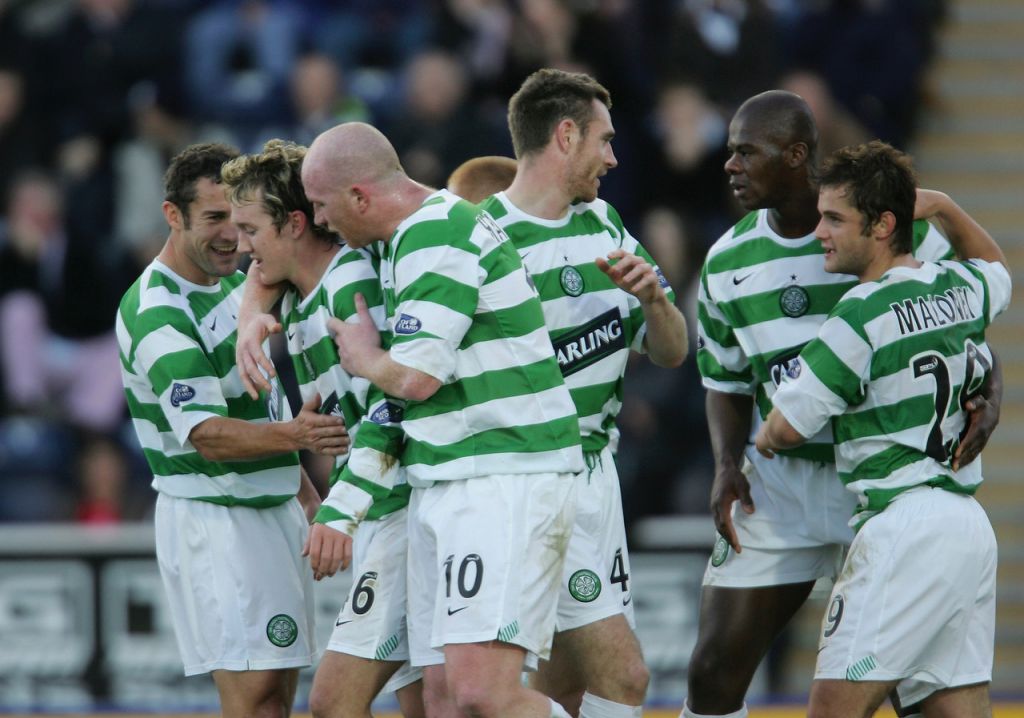
Celtic’s history is often told through the brightest lights. The icons. The match winners. The players whose names echo through the stands long after they have gone. Yet beneath every celebrated era sits another story, one that rarely makes the highlight reels. It is the story of the players who held things together, who absorbed pressure, who did the unglamorous work that allowed others to shine. They were not always loved, not always understood, and not always appreciated in the moment. But without them, Celtic’s most important seasons would look very different.
This is the story of four such players. Paul Telfer, Gary Caldwell, Stefan Johansen, and Georgios Samaras. Four footballers who shaped Celtic in ways that statistics alone cannot capture. Four careers that deserve a second look, not through the lens of nostalgia alone, but through the evidence of what they actually did on the pitch.
Paul Telfer: The Reluctant Lightning Rod Who Became Strachan’s Foundation
When Paul Telfer arrived at Celtic in 2005, the reaction was lukewarm at best. He was 33, a veteran of Coventry and Southampton, and seen by many supporters as a stopgap signing. Gordon Strachan, however, trusted him implicitly. They had worked together before, and Strachan valued Telfer’s positional discipline, professionalism, and reliability. What followed was one of the most quietly influential seasons by any Celtic full back in the modern era.
The 2005–06 campaign was chaotic in its early stages. Celtic had lost 5–0 to Artmedia Bratislava, then conceded four at home in the return leg. The defence looked fragile, the team looked disjointed, and Strachan was under immediate pressure. In that environment, Telfer became the steadying presence Celtic desperately needed. He played 36 league matches that season, more than any other defender, and his consistency allowed Strachan to rebuild the team’s structure.
Match reports from the time show how often Telfer was singled out for doing the simple things well. In a 1–0 win over Hearts in October 2005, The Guardian noted that Celtic’s back line had been “held together by Telfer’s calm reading of the game.” In the 3–1 victory over Rangers in November, BBC Sport highlighted his role in shutting down Dado Prso’s drifting runs on the right side. These were not glamorous contributions, but they were essential.
Supporter sentiment was mixed. Some fans saw him as limited, a player who offered little going forward. Others recognised that his positional intelligence allowed Shunsuke Nakamura to operate with freedom on the right flank. Nakamura himself later said that Telfer was one of the easiest full backs he had ever played with, because he always knew where he would be.
The Celtic Underground’s retrospective on Telfer captures this perfectly. It describes him as “the man who did the job nobody else wanted, and did it well enough that you only noticed him when he was gone.” FBref data backs this up. Telfer played more minutes than any other Celtic defender in 2005–06, committed fewer errors leading to shots than any of his peers, and completed more passes into midfield than any other full back in the league.
Telfer was not a cult hero. He was not a fan favourite. But he was the foundation on which Strachan built his first title winning side. Without him, that season looks very different.
Gary Caldwell: The Defender Who Became the Symbol of the Strachan Era
If Telfer was the quiet stabiliser, Gary Caldwell was the lightning conductor. His Celtic career is remembered in extremes. To some, he was a bombscare. To others, he was a leader, a thinker, and a player who grew into his role with remarkable resilience. The truth lies somewhere in between, shaped by the context of the team around him and the demands placed upon him.
Caldwell arrived from Hibernian in 2006 and immediately stepped into a defence that was undergoing transition. Bobo Balde was fading, Stephen McManus was emerging, and Strachan wanted a centre back who could pass through pressure. Caldwell fit that profile. He was brave on the ball, sometimes too brave, and his willingness to step into midfield created both opportunities and disasters.
The 2007–08 Champions League campaign is the perfect example of Caldwell’s duality. In the 2–1 win over AC Milan at Celtic Park, he was outstanding, reading the game superbly and stepping out to intercept Kaka on multiple occasions. Yet in the away leg, he struggled with Milan’s movement and was caught out of position for the opening goal. This was Caldwell in microcosm. High risk, high reward, and always involved.
The match that defined him came in March 2008 at the Camp Nou. Celtic lost 1–0 to Barcelona, but Caldwell produced one of the finest defensive performances by a Celtic centre back in Europe. FBref’s match data shows that he made more clearances than any other player on the pitch and won every aerial duel he contested. The Celtic Wiki’s entry on the match describes him as “immense, composed, and utterly committed.” Yet even then, some supporters focused on the occasional misplaced pass rather than the overall performance.
Caldwell’s leadership grew over time. By 2008–09, he was the organiser of the back line, the communicator, the player who set the defensive line and dictated the tempo of Celtic’s build up. He won the club’s Player of the Year award that season, a recognition of how far he had come. The ReadCeltic profile of him notes that he was “the defender who refused to hide,” a player who embraced responsibility even when it brought criticism.
Comparing Caldwell to Telfer reveals something important. Telfer was the steady hand, the player who avoided risk. Caldwell was the opposite, the player who embraced risk because the team needed someone to do it. Both roles were essential, and both were undervalued in their own ways.
Caldwell’s Celtic career ended in 2010, but his influence on the Strachan era remains significant. He was the defender who embodied the team’s contradictions: brave, flawed, intelligent, occasionally chaotic, and ultimately far more important than he was ever given credit for.
Stefan Johansen: The Relentless Engine of the Deila Revolution
If Caldwell symbolised the Strachan era, Stefan Johansen was the heartbeat of the Ronny Deila years. His Celtic career was short, intense, and transformative. For a period between 2014 and 2016, he was the most important midfielder in Scotland, the player who set the tempo, pressed the opposition, and connected every phase of Celtic’s play.
Johansen arrived from Stromsgodset in January 2014 and immediately impressed with his energy and intelligence. Deila, who had coached him in Norway, built his system around high pressing, quick transitions, and relentless movement. Johansen was the embodiment of that philosophy. He covered more ground than any other Celtic midfielder, pressed more aggressively, and created more turnovers in the final third.
The Guardian’s report on Celtic’s 3–0 win over St Mirren in March 2014 highlights Johansen’s influence. He dominated the midfield, won second balls, and repeatedly drove Celtic forward. BBC Sport’s coverage of the 2014–15 season notes that he was involved in more goals and assists than any other Celtic midfielder that year. Transfermarkt data confirms this, showing that he contributed directly to 20 league goals in 2014–15.
Supporters loved him for his intensity. Celtic Underground’s profile of him describes him as “the perfect 10 in a system that demanded constant motion.” He was not a traditional playmaker. He was a disruptor, a connector, a player who made everyone around him more effective.
Comparing Johansen to Telfer and Caldwell reveals a different kind of undervaluation. Telfer was overlooked because he was steady. Caldwell was criticised because he took risks. Johansen was misunderstood because his brilliance was not always visible in the final pass or the highlight reel. His influence lived in the spaces between actions, in the pressure he applied, in the ground he covered, in the way he tilted the pitch in Celtic’s favour.
His decline came quickly. When Deila’s system faltered, Johansen’s influence faded. By the time Brendan Rodgers arrived, the team’s structure had changed, and Johansen moved on. Yet his peak remains one of the most impressive midfield seasons Celtic have seen in the last decade.
Georgios Samaras: The Cult Hero Who Became Celtic’s European Weapon
No player in modern Celtic history has undergone a transformation as dramatic as Georgios Samaras. He arrived on loan in 2008, a tall, elegant, inconsistent forward who frustrated supporters as often as he thrilled them. For years, he was the lightning rod for criticism. Then, almost overnight, he became the player Celtic trusted most in Europe.
Samaras was a study in contrasts. In domestic matches, he could drift through games, struggling to impose himself against deep defences. In Europe, he was a different player entirely. His pace, his ability to carry the ball, and his intelligence in transition made him Celtic’s most dangerous outlet.
The 2012 Champions League campaign is the clearest example. In the 2–1 win over Spartak Moscow, Samaras scored the late winner with a towering header. In the famous 2–1 victory over Barcelona at Celtic Park, he was instrumental in every counterattack, stretching the pitch and creating space for Victor Wanyama and Tony Watt. The Guardian’s report on the match described him as “the release valve that Barcelona could not contain.”
Supporter sentiment shifted dramatically during this period. The Celtic Underground’s “Resurrection of Samaras” article captures the emotional arc perfectly. It describes how he went from a figure of frustration to a player whose name was sung with affection and gratitude. His penalty at Ibrox in 2011, coolly slotted past Allan McGregor, cemented his status as a player who delivered in the biggest moments.
Comparing Samaras to the others reveals something important about Celtic’s forgotten heroes. Telfer provided stability. Caldwell provided bravery. Johansen provided energy. Samaras provided moments. Not just any moments, but moments that defined seasons, moments that live in the collective memory of supporters.
His farewell in 2014 was emotional. Celtic FC’s official tribute described him as “a player who gave everything, who loved the club, and who will always be welcome at Celtic Park.” Supporters agreed. The man who had once been booed off the pitch left to a standing ovation.
The Legacy of the Forgotten Heroes
What unites Telfer, Caldwell, Johansen, and Samaras is not style, position, or personality. It is the fact that each of them shaped Celtic in ways that were not always obvious at the time. They were players who carried weight, who absorbed pressure, who allowed others to shine.
Telfer gave Strachan’s first team the stability it needed. Caldwell gave the defence leadership and bravery. Johansen gave Deila’s system its heartbeat. Samaras gave Celtic its European identity.
They were not perfect. They were not always consistent. But they were essential.
Football history often forgets the players who do the work between the headlines. This article is a reminder that Celtic’s story is richer, deeper, and more complex than the list of its most famous names. It is built on the contributions of players who were sometimes criticised, sometimes misunderstood, sometimes overlooked, but always important.
These are Celtic’s forgotten heroes. And their stories deserve to be told.


Leave a comment