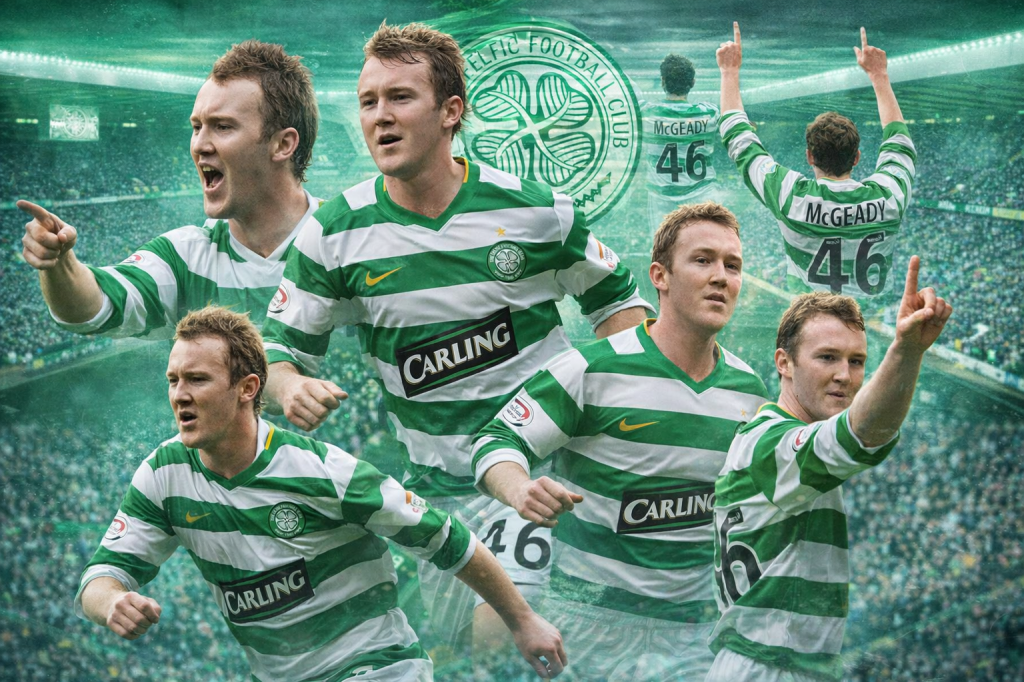
There are players whose Celtic careers can be measured in medals, and there are players whose Celtic careers can be measured in memories. Aiden McGeady sits somewhere between the two, a winger who collected honours, yes, but whose real imprint lies in the emotional topography of the club’s mid‑2000s identity. He was a footballer who could make a stadium gasp, groan, or erupt within the span of a single dribble. A talent who arrived precociously, matured unevenly, and departed controversially, yet left behind a legacy that still sparks debate in pubs, forums, and living rooms across Glasgow.
To write about McGeady is to write about promise, pressure, artistry, and the complicated business of being a homegrown star at Celtic Football Club.
The Arrival: A Debut That Announced a Prodigy
McGeady’s Celtic story begins with a moment that felt scripted for mythmaking. Tynecastle, April 2004. Just 18 years old, thrown into the starting XI by Martin O’Neill, he scored on his debut in a 1–1 draw with Hearts. It wasn’t just the goal, it was the way he played. Confident, direct, unafraid to take on defenders. Supporters who watched that afternoon remember the same thing: he looked like he belonged.
On Kerrydale Street, early posts from that era read like the discovery of a rare mineral:
“He’s got something different. You can see it straight away.” “If he keeps his head right, he’ll be a star.”
The club had produced talented wingers before, but McGeady felt like a new archetype, a modern, technical wide player with a continental swagger. His Irish international allegiance only added to the intrigue. Born in Scotland but choosing Ireland, he carried a cultural duality that resonated deeply with Celtic’s identity.
The O’Neill Years: Learning in the Shadows of Giants
Breaking through under Martin O’Neill was no small feat. This was a Celtic side stacked with personalities: Larsson, Sutton, Hartson, Petrov, Thompson. McGeady was a teenager trying to carve out space in a team built for European battles and domestic dominance.
O’Neill used him sparingly at first, but always with purpose. He trusted McGeady in big games, including Champions League nights where the winger’s fearlessness stood out. Supporters recall his cameo against AC Milan in 2004, a young lad running at Cafu with the audacity of someone who didn’t know he wasn’t supposed to.
He was raw, yes, but he was electric. And in a Celtic side that often relied on power and directness, McGeady’s technical finesse offered something different, a glimpse of what the next generation could look like.
The Strachan Era: Breakthrough, Brilliance, and the Battle of Personalities
If O’Neill introduced McGeady, Gordon Strachan defined him.
Under Strachan, McGeady became a starter, a match‑winner, and eventually the most technically gifted player in the squad. The 2007–08 season was his masterpiece:
- SPFA Player of the Year
- SPFA Young Player of the Year
- Celtic Player of the Year
- Celtic Young Player of the Year
A clean sweep. No Celtic player had ever done it before.
That season, he was unplayable at times. His performance against Benfica in the Champions League, repeatedly roasting Luisão and Maxi Pereira, remains one of the great individual European displays by a Celtic winger. His assist for Scott McDonald against Aberdeen, a slaloming run past three defenders, is still replayed in fan compilations.
And then there was the McGeady Spin, a move so distinctive that FIFA video games literally named it after him. It became a symbol of his Celtic identity: flair, unpredictability, and a touch of street football.
But brilliance often comes with friction.
The Strachan Fallout
The relationship between McGeady and Strachan deteriorated publicly in 2008. A training‑ground argument led to a suspension and a fine. Supporters were split. Some saw McGeady as a fiery young talent unfairly stifled. Others felt he needed discipline and maturity.
On forums, the divide was stark:
“Strachan’s killing his creativity.” “McGeady needs to grow up; he’s not bigger than the club.”
This tension became part of his Celtic mythology, the gifted winger and the disciplinarian manager locked in a creative‑temperamental tug‑of‑war. It mirrored Celtic’s own identity crisis at the time, a club balancing artistry and pragmatism, flair and function, romance and results.
The Player He Was: Strengths, Flaws, and the Eternal Debate
Aiden McGeady was a paradox, a footballer who could glide past a defender with effortless grace, then moments later leave supporters exasperated with a misplaced cross or a heavy touch. He had the ability to dominate a match, to bend its tempo to his will, yet he could just as easily drift through long stretches without leaving a mark. Few players of his era could electrify a stadium the way he could, and few divided opinion quite as sharply.
At his best, McGeady possessed some of the most natural dribbling talent in Britain. His close control, acceleration, and balance made him a nightmare for full backs, many of whom resorted to fouling him simply because they had no other way to stop him. His work rate was often overlooked, yet he regularly tracked back, pressed, and covered ground with a commitment that contradicted the lazy stereotypes sometimes attached to flair players. Above all, he had courage. Even on difficult afternoons, he continued to demand the ball, continued to take responsibility, continued to try to make something happen.
Yet the weaknesses were real. Inconsistency followed him throughout his Celtic career, the criticism that never quite went away. His decision making could falter, particularly in the final third, where he sometimes held the ball a touch too long or chose the more complicated option. His temperament, fiery and emotional, occasionally spilled into conflict, most famously during his clashes with Gordon Strachan.
Roy Keane, who coached him with Ireland, once remarked, “He can play a lot better, maybe that is the story of Aiden’s career.” Supporters still argue about whether that assessment was unfair or simply accurate. In truth, it captures the duality of McGeady perfectly. He was a player whose ceiling was dazzling, but whose volatility sometimes obscured the full extent of his gifts.
The Cultural Layer: Identity, Expectation, and Pressure
McGeady’s decision to represent Ireland rather than Scotland created a storm around him long before he had fully established himself at Celtic. He was booed at away grounds, scrutinised by pundits, and repeatedly asked to justify a choice that was deeply personal. For a young player still finding his place in the professional game, the pressure was immense.
Inside Celtic Park, however, he found acceptance. His Irish heritage resonated with the club’s history and identity, but it also placed a symbolic weight on his shoulders. He became more than a promising winger. He became a representative figure, a local lad with Irish roots who carried the creative burden of a team in transition.
This cultural layer shaped how he was perceived. Some supporters saw him as the next great Celtic winger, part of a lineage that included Jinky Johnstone, Paolo Di Canio, and Shunsuke Nakamura. Others viewed him as a luxury in a league that demanded grit and efficiency. The truth sat somewhere between these poles. McGeady embodied both sides of Celtic’s footballing soul, the hard‑working competitor and the expressive artist, the player who could graft and the player who could dazzle.
The Departure: A Record Fee and a Lingering What If
When McGeady left Celtic for Spartak Moscow in August 2010, the transfer fee of roughly £9.5 to £11 million immediately placed him among the most valuable departures in the club’s history. The destination surprised many. Russia was not a typical move for a British or Irish player at the time, and the decision felt bold, even risky. McGeady wanted a new challenge, and Celtic, entering a rebuilding phase under Neil Lennon, accepted the offer.
Supporters reacted with a mixture of sadness, frustration, and pragmatism. Some lamented the loss of a player who had been the team’s spark for years. Others felt the club had secured excellent money for someone they believed had never fully delivered on his potential. A few argued that he needed a fresh start, that the weight of expectation in Glasgow had become too heavy. Many simply wondered how Celtic would replace his dribbling, his unpredictability, his ability to change the rhythm of a match with a single touch.
In truth, they never really did.
His departure marked the end of an era. He was the last major link to the O’Neill and Strachan years, the final homegrown superstar of that generation, and his exit closed a chapter in Celtic’s modern history.
The Retrospective Lens: What His Celtic Career Really Meant
With time and distance, McGeady’s Celtic career has taken on a different shape. It appears clearer, more balanced, and more appreciated than it often was in the moment. He was, quite simply, one of the finest one‑on‑one dribblers the club has produced in the modern era. Even today, when supporters discuss the need for a winger who can beat a man, the phrase “a McGeady type” still surfaces.
He carried enormous expectation from a young age. He was only 18 when he made his debut, 22 when he became the team’s primary creative force, and 24 when he left. Few players in Scotland have ever been asked to shoulder so much so early.
He was both loved and misunderstood. His personality, emotional and expressive, sometimes clashed with managerial pragmatism, yet that same fire often fuelled his best performances. He left Celtic before reaching his peak, and some of his most complete football arguably came later at Everton, at Preston, and even in flashes at Sunderland. Celtic saw the rise, but not the full bloom.
His legacy is richer than his numbers. Thirty‑one goals and forty‑eight assists tell only part of the story. The real story lives in the moments: the debut goal at Tynecastle, the Champions League masterclass against Benfica, the sweeping awards of the 2007–08 season, the spin, the swagger, the sense that something thrilling might happen every time he touched the ball.
The Verdict: A Career Worth Celebrating, Debating, and Remembering
Aiden McGeady’s Celtic career is not a simple tale of success or failure. It is a story of talent and tension, brilliance and burden, artistry and argument. It is the story of a young man who carried the hopes of a club in transition, who dazzled and divided, who grew up in the glare of a demanding football culture.
He was not perfect. He was not consistent. But he was unforgettable.
And in the end, that is its own kind of greatness.


Leave a comment