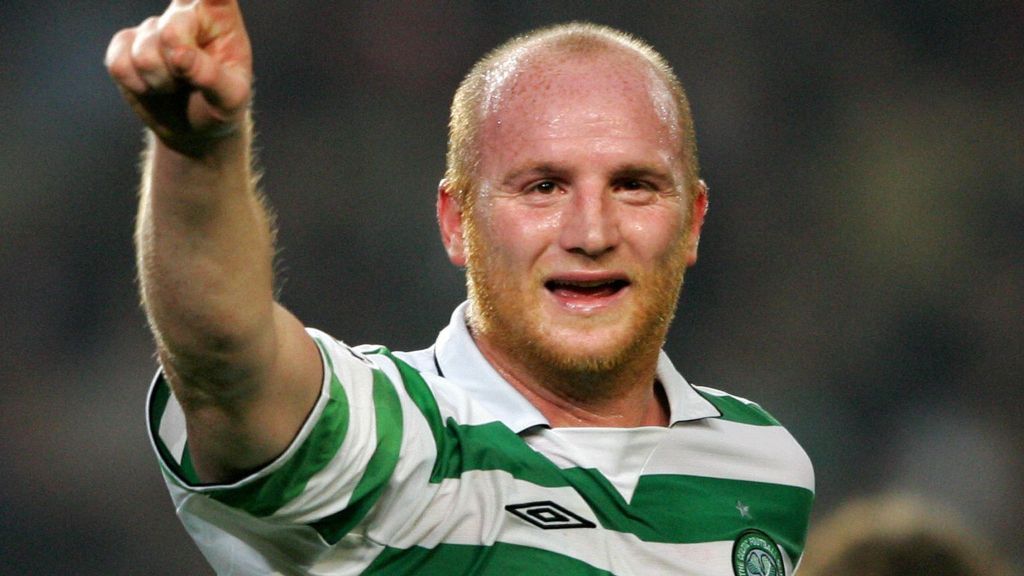
There are footballers who glide into a club like dancers, light on the grass, welcomed with trumpets and silk. Then there are those who arrive like weather fronts, rolling in from distant shores, heavy with rain and rumour. John Hartson belonged to the second kind, a man shaped by storms, a figure who seemed carved from the Welsh cliffs, broad and battered, carrying the weight of a thousand doubts on his shoulders.
When Celtic signed him in August 2001 for £6 million, it was not with the fanfare that greets a saviour. It was a puzzled murmur, a raised eyebrow, a question whispered across pub counters. Why spend so much on a striker who had failed a medical at Rangers the year before, a man whose reputation was as combustible as it was compelling? Supporters wondered where he would fit among the artistry of Henrik Larsson and the muscular elegance of Chris Sutton. Some feared he would be a luxury, others feared he would be a burden.
He arrived with stories clinging to him like barnacles. The infamous training‑ground clash at West Ham, where he kicked Eyal Berkovic, had followed him like a shadow. His body, thick and unglamorous, invited mockery from those who mistook shape for substance. He looked like a man who might be found in a Sunday league, sleeves rolled up, mud on his shins, roaring at the referee. Yet beneath that silhouette was a heart that beat fiercely for the game, a heart that would soon beat in time with the Celtic faithful.
Martin O’Neill saw something others did not. He saw a warrior who could anchor an attack, a man who could turn chaos into opportunity, a striker who could make defenders tremble. He saw a player who would bleed for the badge, who would give everything, who would become a symbol of Celtic’s working‑class soul.
Hartson stepped into Paradise not as a prince, but as a pilgrim. And in time, he would become something rarer, something more enduring. He would become beloved.
Fire and Thunder in the Hoops: The Making of Big Bad John
There are strikers who score goals like brushstrokes, delicate and deliberate. Hartson scored goals like thunderclaps. He was not a man of half measures. When he rose for a header, it was as if the earth itself pushed him upward. When he struck a ball, it travelled with the weight of his entire being, a shot forged in the furnace of his will.
Across 146 Celtic appearances, he scored 88 goals, a tally that places him among the most prolific forwards of the club’s modern era. Yet the numbers alone do not capture the essence of him. His goals were not just moments, they were declarations. They were roars. They were the sound of a man refusing to be anything less than essential.
The chant “Big Bad John” rolled down from the stands like a hymn, a song of affection disguised as menace. It suited him perfectly. He was a battering ram with a poet’s instinct, a man who could bully defenders with his back to goal, then turn and curl a finish into the far corner with surprising tenderness. He was a storm that could suddenly become a breeze.
His partnership with Larsson and Sutton became one of the most iconic attacking trios in Celtic’s history. Larsson was the artist, Sutton the architect, Hartson the hammer. Together they built seasons of glory, lifting three Scottish Premier League titles and forging memories that still glow in the minds of supporters.
There were goals that felt like folklore. The volley against Liverpool in the UEFA Cup, struck with a purity that seemed to split the night open. The towering headers that bent matches to his will. The scrappy tap‑ins that spoke of persistence, of hunger, of a man who never believed a ball was truly lost.
He played with a kind of volcanic sincerity. Every challenge, every sprint, every leap felt like a promise kept. He was not graceful, but he was grand. He was not elegant, but he was elemental. He was fire and thunder in the hoops
Nights of Glory and Agony: Europe, Seville, and the Weight of Expectation
If domestic football was the canvas on which Hartson painted his strength, Europe was the cathedral where he carved his legend. Under Martin O’Neill, Celtic strode into continental competition like a band of warriors, their hearts full of defiance, their bodies carrying the bruises of battles fought on Scottish soil.
Hartson was central to that march. His goals in Europe were not plentiful, but they were precious. He scored 2 goals in 14 Champions League appearances, and his contributions in the 2002–03 UEFA Cup run helped propel Celtic toward the shimmering horizon of Seville.
That season felt like a pilgrimage. Celtic travelled across Europe with a sense of destiny, their supporters following in numbers that astonished the continent. Hartson, often playing through pain, became the battering ram that softened defences for the artistry of Larsson and the intelligence of Sutton.
And then came Seville.
The city glowed like a dream, its heat rising from the streets like incense. Celtic supporters filled its squares with songs, their voices weaving through the orange trees. The final against Porto was a night of shimmering hope and cruel exhaustion. Celtic fought with every fibre of their being, but the match slipped away in extra time, leaving behind a heartbreak that still lingers like a bruise.
Hartson did not score that night, but his presence was felt in every duel, every surge, every moment when Celtic refused to bow. He carried the weight of expectation with a kind of stoic grace, a man who knew that glory and agony often walk hand in hand.
Europe gave Hartson some of his finest hours, but it also revealed the toll the game took on him. The nights under the floodlights were beautiful, but they were brutal too. And the body that had served him so faithfully began to falter.
Battles Within: Injury, Mortality, and the Quiet Courage of a Celtic Warrior
Even mountains crack. Even iron bends. And even the strongest warriors discover that their greatest battles are fought not against opponents, but against themselves.
Hartson’s Celtic years were marked by recurring injuries, the kind that gnaw at a player’s confidence, the kind that turn every sprint into a question. He played through pain more often than he admitted, his body a patchwork of bruises and strains. Yet he never hid. He never asked for sympathy. He simply carried on, as if duty were a kind of prayer.
By 2006, the toll had become too great. He retired from international football after 51 caps and 14 goals for Wales, a record that spoke of loyalty and pride. That same year, he left Celtic, signing for West Brom, his departure quiet and dignified, like a warrior laying down his weapons.
Then came the battle that dwarfed all others.
In 2009, Hartson was diagnosed with testicular cancer that had spread to his brain and lungs. The news struck the football world like a cold wind. Supporters who had once cheered his strength now prayed for his survival. And in the face of mortality, Hartson revealed a courage that surpassed anything he had shown on the pitch.
He fought. He endured. He survived.
His recovery became a beacon, a reminder that even in the darkest valleys, there is light. He emerged not just as a former footballer, but as an advocate, a voice urging men to seek help, to speak openly, to confront their fears.
In punditry, he found a new calling. His voice softened, his insights sharpened, his presence became one of warmth and wisdom. The warrior had become a storyteller.
Legacy of a Folk Hero: The Man Who Gave Everything
Some players are remembered for their touch, others for their trophies. John Hartson is remembered for the way he made people feel, the way he turned effort into poetry, the way he transformed sweat into something sacred.
He was not perfect. He was not polished. But he was honest. He was wholehearted. He was a man who gave everything, every time, without hesitation.
Celtic supporters embraced him not because he was the most graceful, but because he was the most human. He embodied the club’s spirit, its grit, its working‑class soul. He was a striker who looked like he had lived a life, who carried his struggles openly, who fought for every inch.
On forums, in pubs, in the quiet corners of memory, his name is spoken with affection. He is a cult hero, a folk figure, a reminder that football is not just about beauty, but about bravery.
He once said, “I was never a great, great player. I was just somebody who gave his heart and soul into every performance.”
In that humility lies the truth of him.
John Hartson’s Celtic story is not one of perfection. It is one of perseverance. It is a tale of a man who arrived as a question and left as an answer. A man who stepped into Paradise uncertain, and walked out immortal.


Leave a Reply