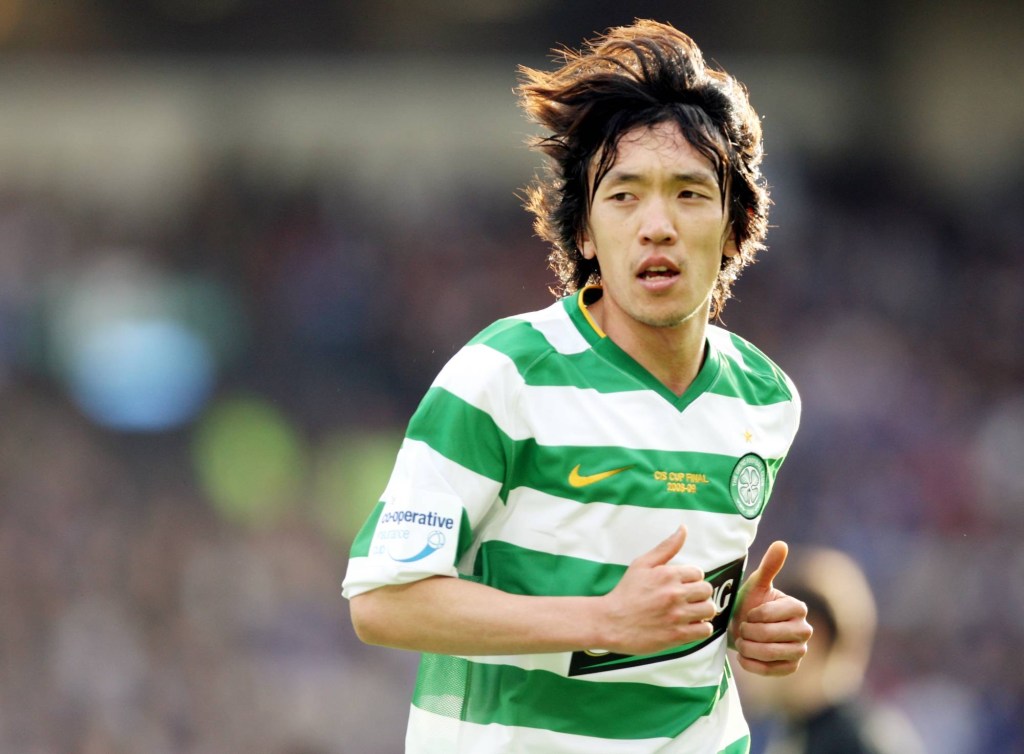
There are moments in football when time folds in on itself, when the present brushes against the past with a soft, almost reverent hand. Shunsuke Nakamura stepping once more onto Scottish soil with the Japanese national team this week feels like one of those moments. It is as if the air itself remembers him, as if the wind that curls around Celtic Park carries faint echoes of his left foot, that elegant instrument that once bent reality to its will. Supporters speak of him with a warmth that has not dimmed, a warmth that seems to glow brighter whenever he returns, even briefly, to the place where he carved his legend.
His presence in Scotland is not simply a nostalgic footnote. It is a reminder of a player who changed Celtic’s identity, a player who arrived quietly and left indelible marks on the club’s history, its culture, and its imagination. Nakamura was not just a footballer. He was a craftsman, a poet, a painter of moments that shimmer still in the collective memory of a support that cherishes artistry as deeply as it cherishes victory. His return invites reflection, and reflection invites gratitude, for few players have ever played the game with such grace, such intelligence, such quiet and devastating beauty.
The Signing That Shifted the Horizon
To understand Nakamura’s impact, one must return to the summer of 2005, a summer of transition and uncertainty. Celtic were stepping out of the shadow of the Seville era, adjusting to life after Martin O’Neill, and placing their trust in Gordon Strachan, a manager with a different vision and a different rhythm. The squad was evolving, the style was shifting, and the club stood at a crossroads where identity and ambition intertwined.
Into this landscape walked Shunsuke Nakamura, a slight, soft‑spoken playmaker from Reggina, a player whose reputation for technical brilliance was well known in Italy but whose suitability for Scottish football was questioned by many. The league was defined by physicality, by intensity, by a kind of rugged defiance that seemed at odds with Nakamura’s delicate touch and feather‑light balance. The scepticism was predictable, almost inevitable, yet it missed the deeper truth that Strachan understood. Celtic needed a conductor, someone who could bring harmony to the chaos, someone who could elevate the team’s style without sacrificing its competitive edge.
Nakamura became that figure. From his earliest appearances, it was clear that Celtic had acquired something rare. His first touch seemed to soften the ball, as if he were coaxing it into obedience. His passing carried a sense of intention, a sense of geometry, a sense of seeing the pitch not as a battlefield but as a canvas. He played with a serenity that contrasted beautifully with the storm around him, and in doing so, he began to reshape Celtic’s footballing identity.
Moments That Became Mythology
Every great Celtic player is remembered for moments, those flashes of brilliance that become part of the club’s folklore. Nakamura’s catalogue is rich, varied, and unforgettable, yet three moments rise above the rest, three moments that define his legacy with a clarity that time cannot erode.
The Free Kick Against Manchester United
There are goals, and then there are moments that feel touched by something beyond technique. Nakamura’s free kick against Manchester United in 2006 belongs to the latter category. The stage was immense, the stakes enormous, the opponent formidable. Celtic needed something extraordinary, and Nakamura delivered it with a strike that seemed to defy physics. The ball rose, dipped, curled, and whispered its way into the top corner with a precision that felt almost supernatural.
It was not simply a goal. It was a statement. It was Celtic announcing themselves on the European stage with a flourish of artistry. It was Nakamura revealing the full extent of his genius to a world that had not yet fully understood him. It was the moment that propelled Celtic into the Champions League last sixteen for the first time, a moment that still sends shivers through supporters who witnessed it.
The Second Free Kick at Old Trafford
To score one free kick of such quality against Manchester United is remarkable. To score another, at Old Trafford, is something else entirely. The audacity of it, the calmness, the technique, the sense of inevitability as he stepped up to the ball. It was as if he were painting a second masterpiece on the same canvas, each stroke deliberate, each movement precise.
This goal cemented his reputation across Europe. It confirmed that his brilliance was not confined to domestic competition. It showed that he could bend the game to his will against the very best, and it elevated him from admired player to Celtic icon.
The Kilmarnock Title Winner
If the Manchester United goals were moments of beauty, the free kick against Kilmarnock in 2007 was a moment of destiny. Celtic needed a goal to secure the title, and the pressure was immense. Nakamura stood over the ball with the calm of a man who understood that this was his moment, that the narrative had been building toward this point.
The strike was perfect. The celebration was pure release. The significance was immeasurable. Supporters still speak of that day with a kind of reverence, for it was the moment when Nakamura’s artistry met Celtic’s need, when beauty and necessity intertwined to create something unforgettable.
The Artist in a Warrior’s League
Scottish football has long been defined by its physicality, its intensity, its relentless pace. It is a league that rewards strength, resilience, and determination. Into this environment stepped Nakamura, a player whose gifts lay in subtlety, in vision, in the delicate manipulation of space and tempo. He was an artist in a league of warriors, yet he never looked out of place.
He adapted, not by changing who he was, but by expanding what he could be. He worked tirelessly, pressed intelligently, and showed a defensive awareness that was often overlooked. Opponents respected him, not only for his skill but for his courage, for his willingness to endure the challenges that came his way without complaint or theatrics.
His influence extended beyond his own performances. He elevated those around him. Aiden McGeady found new freedom. Shaun Maloney discovered new angles. Paul Hartley and Neil Lennon found new rhythms in midfield. Nakamura became the quiet centre of Celtic’s play, the point around which everything else revolved.
Culturally, his impact was profound. He opened the door for Japanese players in Scotland, creating a pathway that would later bring Kyogo, Hatate, Maeda, and others to Celtic Park. He expanded the club’s global reach, drawing supporters from Japan who saw in Celtic a place where their hero had been cherished and understood. He became a symbol of Celtic’s evolving identity, a reminder that the club’s heart beats not only with passion but with creativity, intelligence, and imagination.
A Legacy That Still Glows
As Nakamura returns to Scotland this week, the affection that greets him is not simply nostalgia. It is recognition. It is gratitude. It is the enduring warmth reserved for those who gave something beautiful to the game and asked for nothing in return.
His legacy lives on in the current Celtic squad, in the Japanese players who follow the trail he blazed, in the supporters who still speak his name with a softness that reveals how deeply he touched them. His influence can be seen in Celtic’s recruitment philosophy, in the club’s embrace of technical excellence, in the belief that artistry has a place alongside intensity.
Even after leaving Celtic, Nakamura continued to play with elegance and longevity, returning to Japan and extending his career with the same quiet professionalism that defined his time in Scotland. His journey into coaching reflects the same thoughtful approach that shaped his playing days, a desire to teach, to guide, to nurture the next generation.
For Celtic supporters, he remains a figure of almost mythic quality, a player whose highlights are replayed not out of habit but out of joy. His free kicks are studied, his passes admired, his presence remembered with a fondness that time has only deepened.
The Final Note
Shunsuke Nakamura’s return to Scotland is more than a visit. It is a reminder of a time when Celtic’s football felt touched by something magical, when a quiet man from Yokohama brought lightness to a league of shadows, when artistry and courage combined to create moments that will live forever in the hearts of those who witnessed them.
He was, and remains, a maestro. A player who saw the game differently. A player who made Celtic feel enchanted. And as he walks once more on Scottish soil, the land seems to whisper his name, grateful still for the beauty he left behind.


Leave a Reply